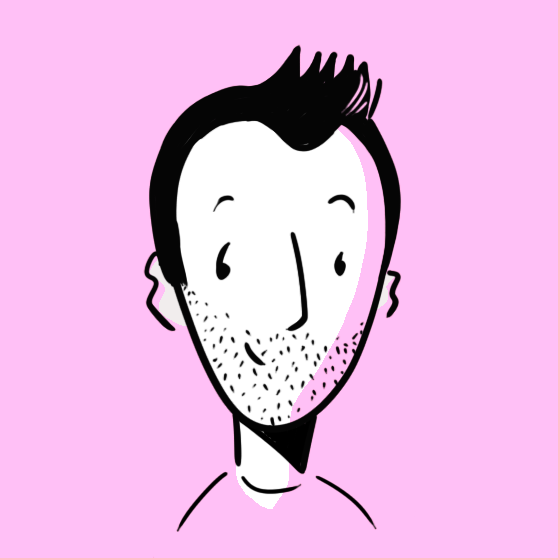
Before I put a mark on paper, I know whether what I’m about to do is a commercial act. Is there a contract? A fee? An expectation? A problem I’ve been asked to solve? That changes things. That first mark and each one after it contains someone else’s need which means I’m asking myself, “What will they think?” With that mindset, I find myself self-editing in anticipation of what I have to do next: get approval and get paid. Things are different when commerce is not part of the process. I don’t need a reason beyond, “I like it”. That’s liberating because sometimes, I just feel like drawing flowers.
All observations
Other people are infectious
Every morning, at the local coffee shop, there’s a ‘happy lady’ (I don’t know her name). She is friendly, she smiles and laughs, she is, quite simply, a joy. Her presence does a more effective job of lifting my mood and helping me focus than the caffeine from the coffee I’m there to drink.
For any artist, the balance between socialising and isolation is always tricky. What helps to choose between socialising and isolation isn’t whether I’m alone or not alone, it’s about what changes in me when I’m with others, for good or bad.
If I can’t draw a circle
If I can’t draw a circle I won’t be able to draw a sun, a car tyre, or a face. If I can’t draw a cube I won’t be able to draw a box, or a house, or a camera. It may not seem exciting. It may seem slow. But if the fabric of the universe begins with atoms, maybe I should too.
No shortcuts
You may be able to find a tool or technique to make a process or drawing more efficient. A digital camera show the photographer the result of their work quicker than a film camera, but it doesn’t make the photo better or the photographer more competent. One still needs to understand tone, colour and composition to take better photos. The speed of the digital results may help us learn more quickly, but to learn anything from the process we have to be aware of the fundamentals first. There are just no shortcuts.
Caring when no one else does
When I begin a project for myself, before there’s a contract, a market or an audience, no one else but me knows about it. No one else but me is responsible for the time it takes and the quality of the result. Because of this, I have no choice but to care deeply about it and produce the work to a level I consider “good enough” or satisfactory to whatever bar I set for myself.
It’s difficult to care for something when no one else does, but it’s also the point.
The purpose of a purpose
What’s the point of a “Purpose” – the core reason a business exists beyond making money. It should make decisions easier to make (e.g. what decision here helps me improve my chances of fulfilling the purpose). It should help contextualise a stressful period (e.g. I’m stressed right now, but it’s for something greater than myself). It should help motivate (e.g. I’m struggling today, but X is bigger than me).
But holding a purpose in one’s mind is difficult in times where one needs it most. That doesn’t mean we don’t need one, in fact, quite the opposite, because without one, what’s the point?
Batteries not included
I own a few cameras: some fancy digital ones and some less fancy film ones. But only one of them doesn’t require batteries. It’s glorious. No charging. No risk of running out of power. It will still take photos in a day, week, or month long blackout.
My pencil will still write on paper. My sharpener will still sharpen the pencil. My brush can still makes marks on a canvas. My stick can still cut grooves into dirt.
Sometimes it’s easy to forget how little we need to an express an idea or feeling. In a world that’s designed for hyper-optimisation and hellbent on convincing us we need another specific tool or technology, it’s worth remembering that a stick and some dirt can do the job just fine.
Inside influence
Most people I know create wholly new ideas from other ideas that came before – a remix or combination that no one thought to put together before. Humans don’t live in a vacuum: we are influenced by other people, times and places, both in very recent history but also in the course of our whole lives. We bring something unique to our ideas because of our individual life journey, our physiology, co-ordination, beliefs, and values.
It’s virtually impossible to make something completely devoid of any outside influence because to make something that hasn’t existed before, we need to know what’s existed before (and not make that).
It follows then, that the fastest path to originality is simply to make and continue to make, one piece after another. If one makes enough, we eventually override the level of influence of external ideas and we begin to create new ideas from our own ideas. Outside influence is replaced by Inside Influence and that creates the condition for something entirely new.
The problem with tutorials
Making someone else’s project in order to learn a new skill or technique seems like a good idea in the beginning. After all, the skill or idea I’m trying to learn is difficult enough so, to reduce the number of parts, I’ll focus on copying the steps rather than also having to invent my own idea to before I begin.
The problem I have with this approach is that I don’t find it very ‘sticky’ or motivating. I have much more success in learning new skills when they come from an idea or a project I’m trying to make but I don’t yet have the skills to make it. I then go looking for the skills to help me execute my vision.
When it’s my vision, the purpose or drive to make comes from within and what I end up with at the end of all that hard work is a thing I made for me, not a copy of someone else’s thing.
A wider existence
To do anything better, one needs practice. To improve drawing, draw more. To become a better pianist, spend more time at the piano. To become a better cook, cook more. To get stronger or fitter, exercise more.
But there are only so many hours in a day.
One school of thought says, “focus”. Pick a priority and spend more time on that. This is how one goes from amateur to pro. From very good to exceptional. From a jack-of-all-trades to a specialist.
A little bit of each, each day, probably won’t make me exceptional at any one thing. But there can be enrichment in diversity. It’s just a different kind of improvement.
Yes, perhaps to ‘run a business as an illustrator’, one probably needs to be exceptional. The same probably goes for being a professional athlete, chef, or concert pianist. But by definition, most of us are not exceptional and have ‘regular’ jobs with rich & diverse interests, hobbies, and lives.
Neither path is ‘better’ than the other, the more important thing is to recognise and understand the choices we make and why. Only then do we avoid regret.