I come from a background in Agile software development which has instilled in me a habit of running small, low-cost experiments to learn new things quickly. I take those new things I learn, and then iterate on their solution until I get something that works just right. It allows me to move quickly and cheaply.
I’ve approached my art career in the same way so far and it’s been working out a treat. I don’t think there’s a better example of this approach than how my studio palette has evolved over the years.
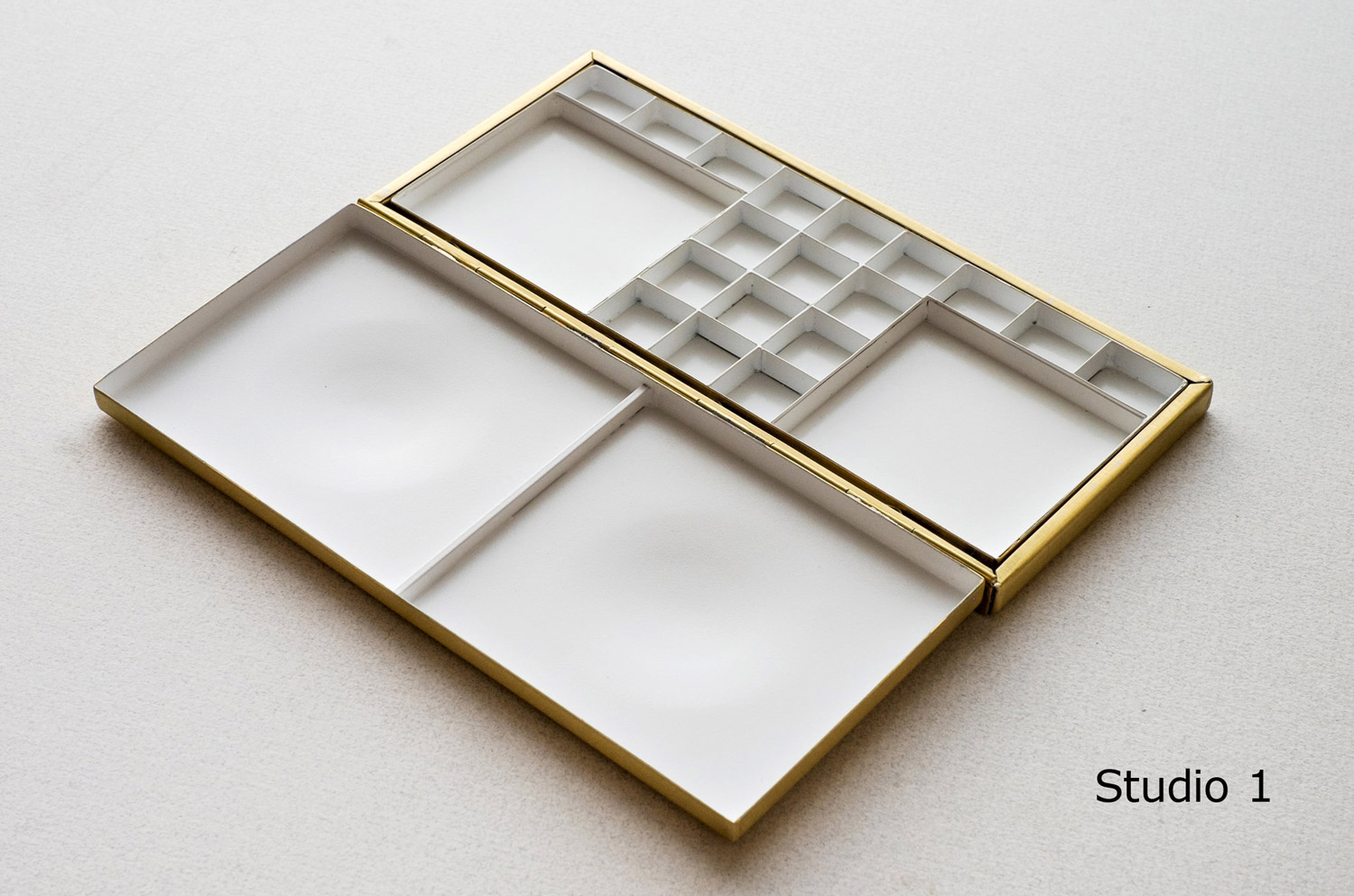
The problem is, I’m a sucker for beautiful art supplies. I’ve lusted for years over a brass studio palette with beautiful big pans and swathes of mixing area.
But every time I think I’m ready to take the plunge and spend around 500GBP (that’s about 1000AUD at the time of writing YIKES), I just can’t imagine moving away from my super flexible, lightweight approach to what I’ve got right now.
My Current Studio Palette
It’s ugly, and probably not going to get too many Instagram likes, but I love it.
My ad-hoc, hacked-together palette has become a core part of my workflow and it’s been with me for 5 years now. It’s ugly, and probably not going to get too many Instagram likes, but I love it.
What’s my palette I hear you ask? It’s quite simply:
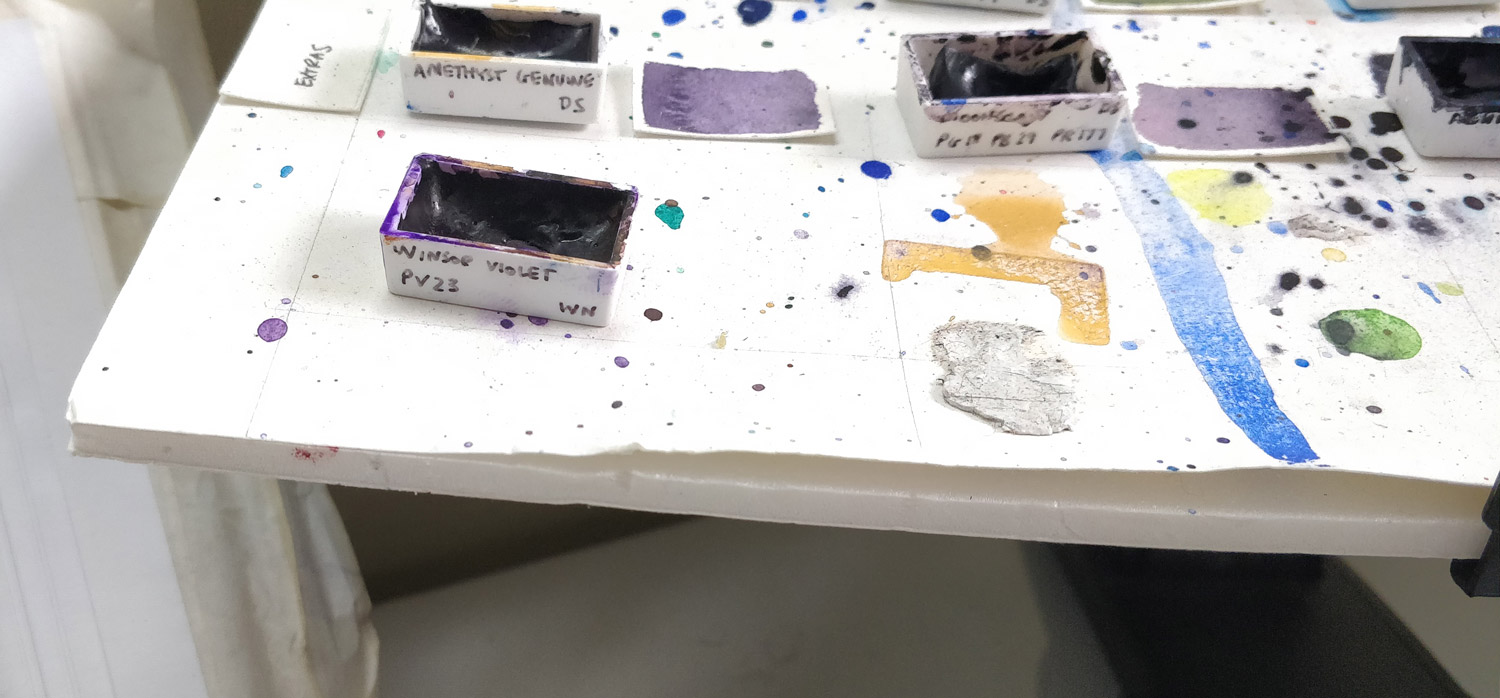
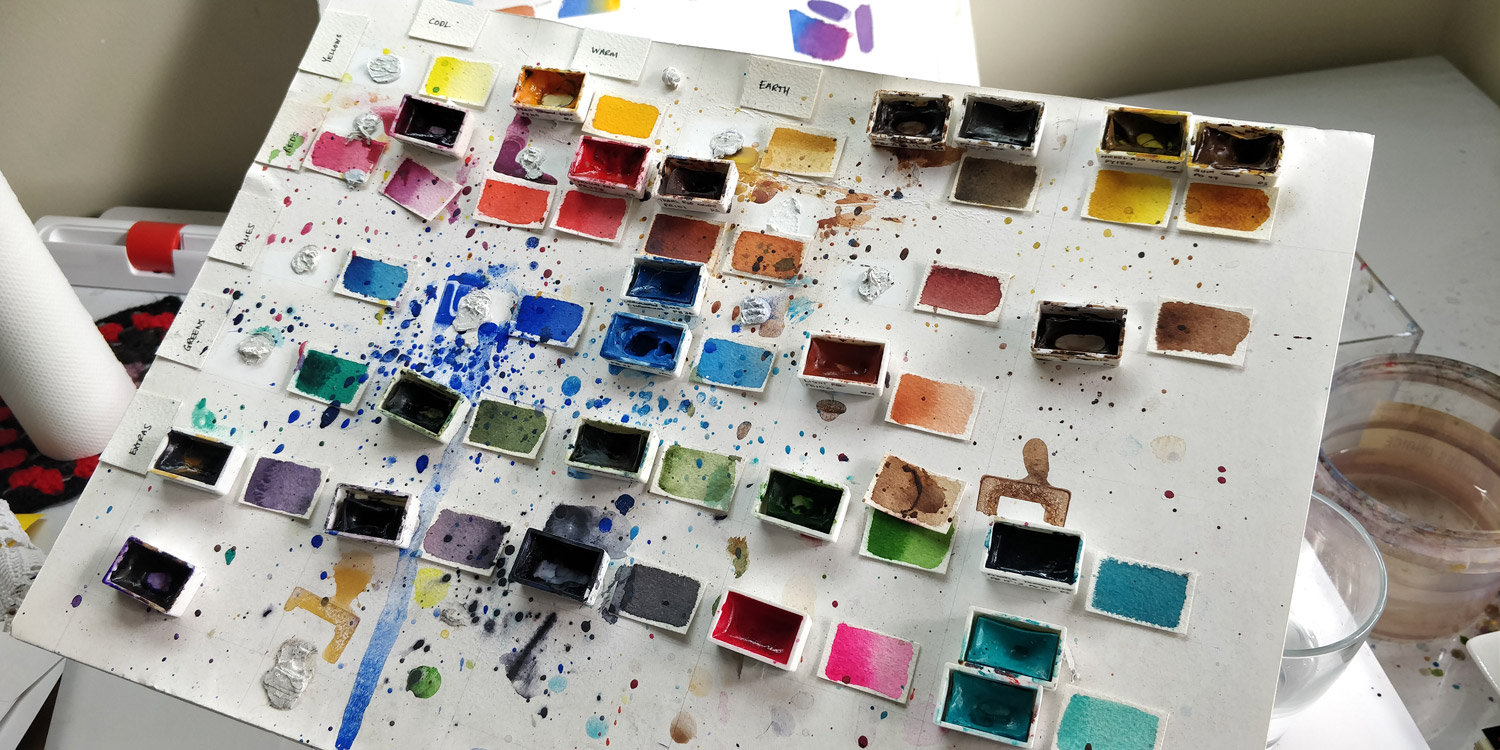
A bunch of regular old watercolour pans (60c each),
blu-tacked to a small piece of foamcore ($1.20),
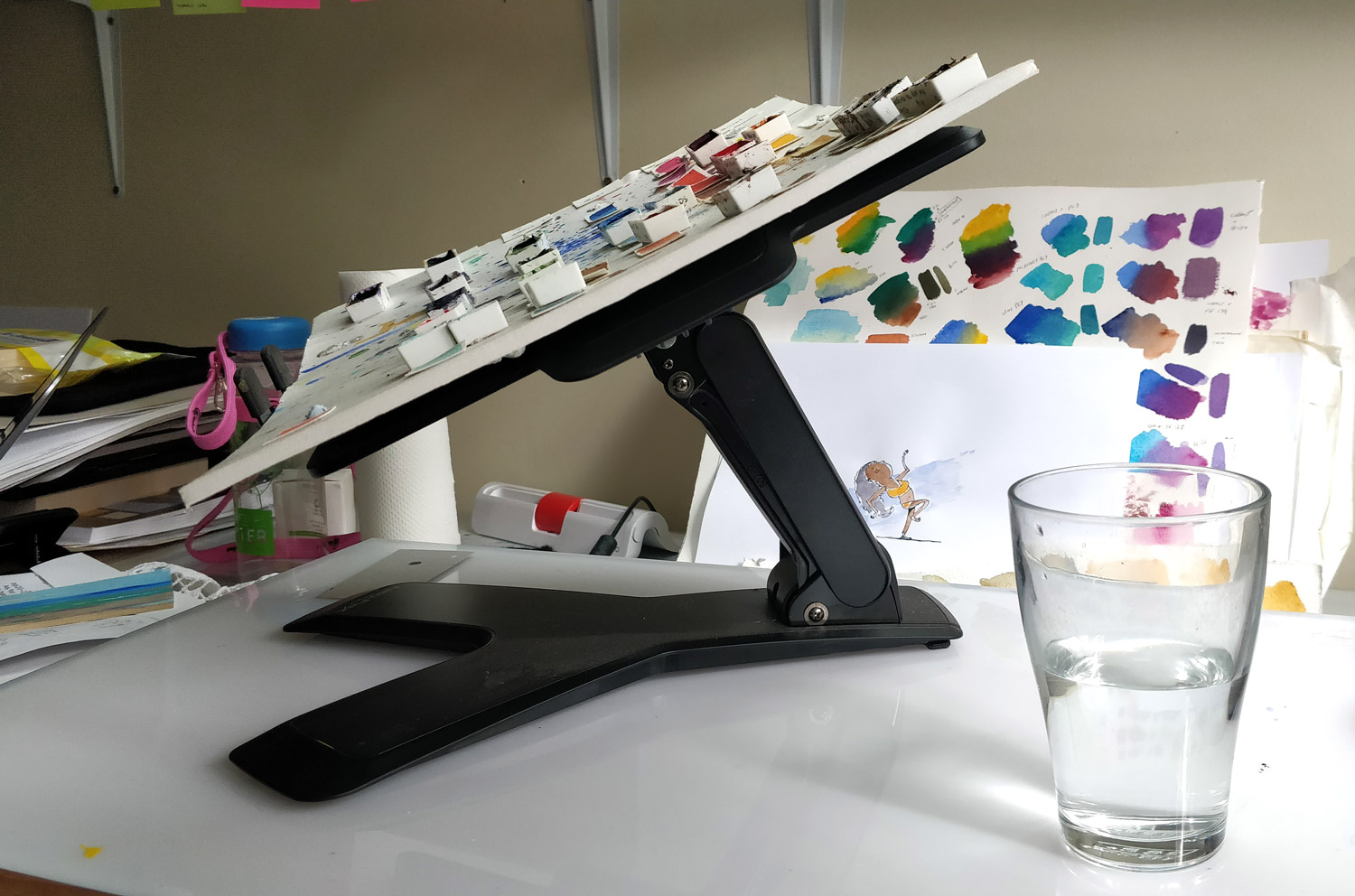
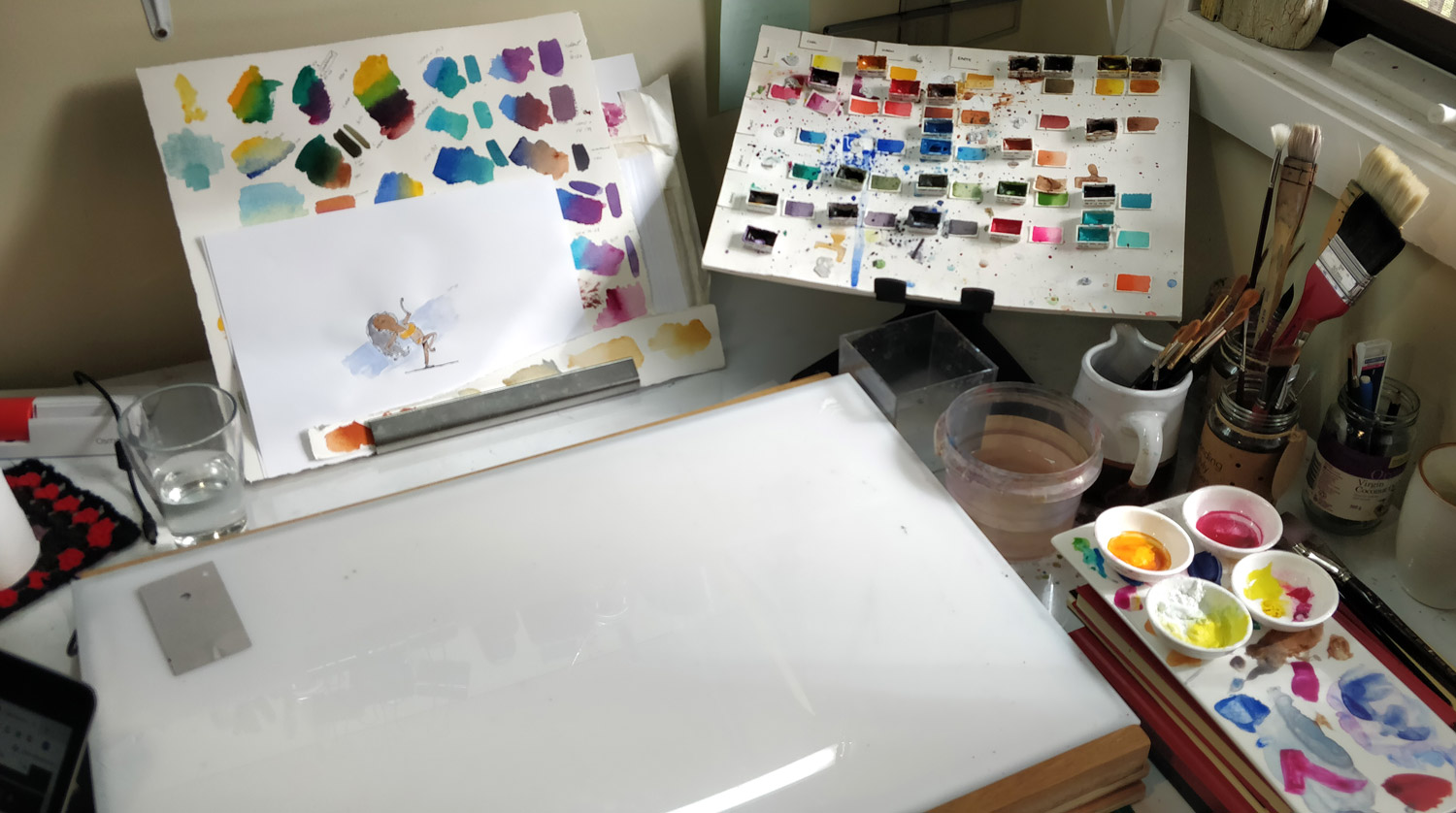
which sits on an ergonomic, 15″ laptop stand ($129 – I’ll explain why I splurged in a minute)
So, for a total of about $144, I’ve got the perfect studio palette. And, until I splurged for the laptop stand, the palette cost was a grand total of $15.
Before the laptop stand, the piece of foam core was glued to an 4×2 block of wood so I could have it an angle. The reason I ‘upgraded’ to a laptop stand was mainly due to the tight space in which I work. I don’t have a fancy, light-filled studio. It’s just my spare room. But the constraint means that I’ve had to think very creatively about how I organise my space.
The foamcore has seen better days, but it still does a great job in acting as the base to which I blu-tac my pans.The foam core sits nicely on this 15″ laptop stand. The laptop stand means I can easily change the angle of the palette to suit what I’m painting.
The wonderful thing about using standard-sized, regular watercolour pans is that when I travel, I can just quickly pluck some very familiar colours from my studio palette and put them in a little travel palette and run out the door. That’s why you can see there are a few colours missing from these photos below. It also proves that yes, there’s nothing fancy, it’s just blu-tac.
It’s easy to add, replace and remove colours whenever I want, like when I travel.
Using blu-tac has other advantages too. Not only is it good for travel but it’s also good for experimenting with how I arrange my colours. I’ve iterated on this a number of times too. Do I follow the colour wheel? Do I arrange warm and cool colours together? I can do a complementary colour pair arrangement if I want. In the end, I settled on an arrangement inspired by watercolour artist Jane Blundell. It’s a 3×3 grid of cool/warm/earth and primary colours. As I’ve illustrated more books, I’ve also added some greens and a few other specialty colours over time.
This gives you an idea of why the laptop stand was the right choice. It fits snugly in this corner and the support arm elevates it above everything, giving me plenty of desk space. It’s also within easy reach of my work area, my brushes, my water pots, and my mixing palette (which, by the way, is just a serving plate I picked up at DFO, Australia’s version of Home Depot) for about $4.
So there you have it. Simple, flexible and maybe not so elegant. In my quest to learn and improve I’m certain that the palette will continue to evolve both in colour choice and how I’ve arranged it. And I’m open to that, when the time is right.
I’m an avid listener of the Plein Air Podcast – a podcast that spends a good hour or so with an individual artist who shares some of their deep insight from a career in art. Yes, it’s decidedly and narrowly American, but there’s some good advice there. And recently, I’ve come to read some of it as bad advice too. One piece in particular.
The host often asks a question like, “We have a lot of beginners in the audience, what’s the one thing you would stress that they learn before anything. What’s the most important thing?” And, nine times out of 10, they say that word – values.
I’m not going to write about what they mean by ‘values’. There has been enough written about what they are and how they work in painting. But, the thing with values is, they’re boring. Well, at least I find them boring.
The classic value exercise is to do grayscales or to paint a picture using one colour (and white). The theory is that you can still make a good painting like this because you’ve still got tonal contrast. I heard one interviewee say something like, “It’s like watching a black and white movie. It has tonal contrast only, there’s no colour, and you can still see what’s going on.”
And yes, I don’t disagree with that. Tonal contrast can make a painting sing. But, what I take issue with is telling beginners to start with the most boring part of painting. Painting is a joyous activity. The feeling of shmooshing a brush or a palette knife through an oily liquid is, for me, a multi-sensory experience like nothing else. I also LOVE colour. I love heaps of colour, all colours, the colour wheel, the brights, the dulls. Making new colours from other colours. All of it. Pasting a surface with a multitude of colour is a visceral experience. Seeing how the thickness of the paint moves, how it changes as it dries, what happens when you go back over it – it’s all part of painting. Does that make a ‘good’ painting? Well, I’ll ask another question, “Who cares?”
Do what feels good and worry about the other stuff later.
If you are a beginner and have found an urge to paint, here’s my advice: Forget values, forget colour theory, forget all the ‘technicalities’. You can sit there and listen to podcast after podcast about what you should or shouldn’t do, attend a million demos from professional artists all who will all give you conflicting advice. But that won’t make you paint. My advice? Just paint. Pick a few cheap colours from the store (maybe start with acrylics because they’re easier to clean up) that make your heart sing. Buy a cheap surface (or you can even use scrap wood like I did my first time), and just start. Do what feels good and worry about the other stuff later.
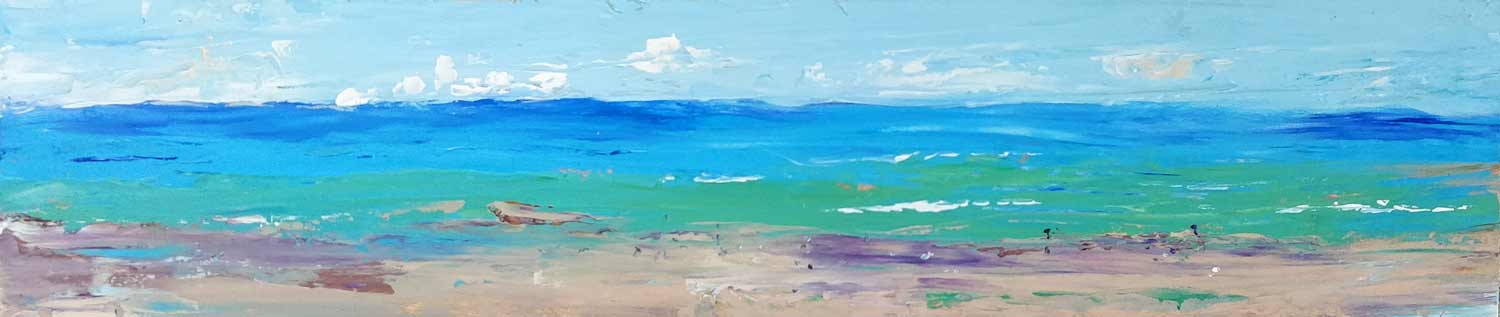
My first ‘painting’. There’s lots I don’t like about it, but there’s lots I loved about feeling the process.
After you slap your favourite colours all over a surface and the rush of emotion drains away, you’re left with a painting. Chances are that painting is not going to win any awards right away, but that’s OK. What beginners really need is to fall in love with the actual process of painting, not the idea of painting. What will happen is that once you’re done, you’ll think, “Wow, I’m awesome, what a great thing! I can’t believe I made that!”… And then you wake up the next day.
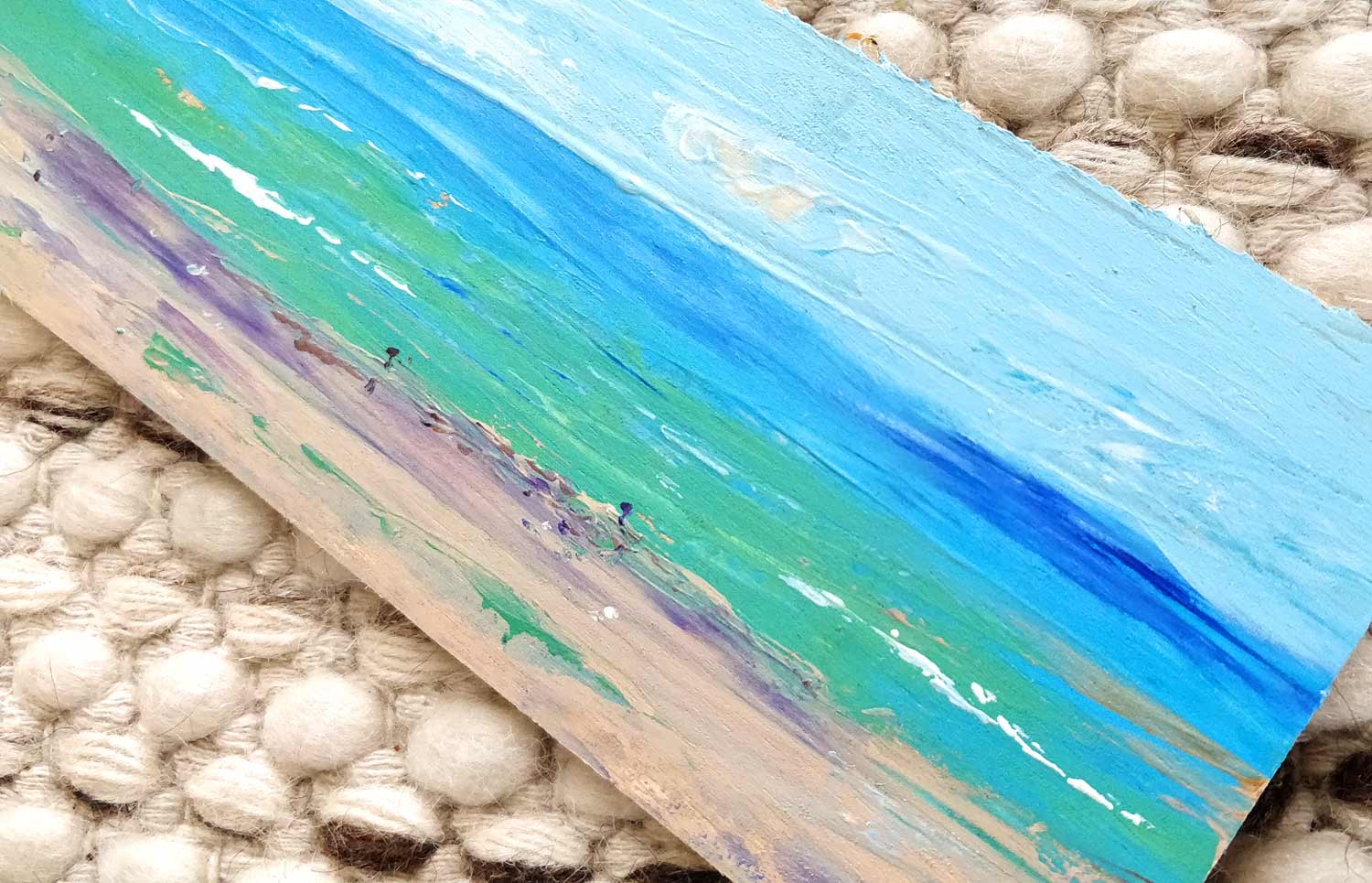
My first painting on a scrap piece of wood I found in the shed. After a few years in watercolour, I loved the idea that I can have nice thick paint.
No matter what your experience level with painting, when you awake the next morning and look at yesterday’s mammoth achievement, you’ll find things you don’t like. It might be that the colour is not as bright as you can see in your head. Or that the shape you thought was perfect is actually a little wonky. That’s perfectly normal and, if you’re moved to fix it, well, welcome to a life-long journey in art.
If you feel the urge to ‘fix’ your first painting, go and get another scrap of wood or painting surface and do the same painting again, but with your newly-seen improvements. Keep the first painting forever. Over time, you’ll learn from mistakes. You’ll seek out specific instruction for taking you to the next level. You’ll get to values eventually if you find that you enjoy painting realistic things. If you turn out to enjoy abstract painting, then values don’t matter anyway.
The only advice a beginner needs is to start painting. It’s not the most efficient, cheap or methodical way to getting ‘great paintings’. But, doing this is the quickest way to joining the rest of us painters in a life-long fulfilling addiction to art and learning to see. In the end, that’s the whole point of painting.
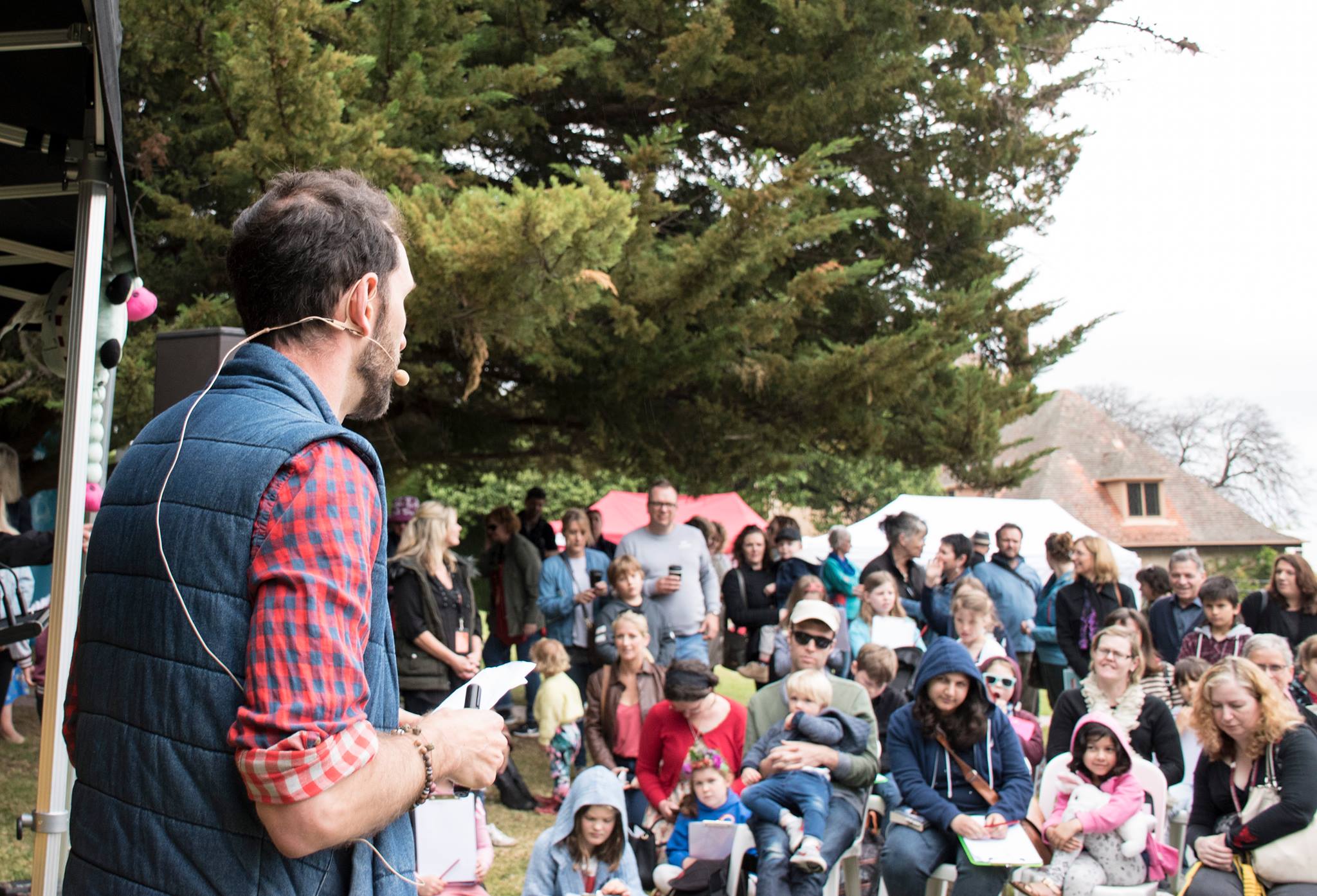
I’m looking forward to running a workshop with forty lucky kids as part of the Brimbank Writers’ and Readers’ Festival 2018 in Victoria. It’ll be happening on Saturday, 10 Nov 2018 starting at 2pm.
Here’s the gist:
Do you want your own personal letter from Matt’s CBCA Notable award-winning character, Eric the Postie? Matt will spend this session guiding children and parents in the lost art of letter writing (one of Eric’s favourite activities ever!)
Kids will end the session by ‘posting’ their own letter to Eric. Then, a few weeks later, Eric will send individual letters out with a personal reply! All replies include a Wattleford Post letterhead, a signature of Eric, all hand-typed on a typewriter. Parents and children will be notified when they can collect their letters from Deer Park library a week or so after the event.
In 2017, I travelled with my family to the middle of Australia. And when I say middle, I mean that. Riiiight in the middle. The heart of the country. A place where the sand is as red as blood. No matter how much you prepare for it, it always takes your breath away. It took over seven days to drive from my home in Melbourne to Uluru. Suffice to say, it was an incredibly moving experience for many reasons.
What’s Australia anyway?
See, technically I grew up in ‘Australia’. But, my version of Australia was, fair to say, pretty narrow. In fact, until I moved to Melbourne in 2016, my version of Australia was only what existed in an approximately 50km radius from where I lived. My parents weren’t big driving-holiday folks, or travelling folks in general, so I had never experienced a ‘proper’ country town, or any sort of rural life at all.
I’ll be honest, the time on the trip flew, but it was probably one of the most interesting, moving and exciting experiences of my life. There’s something about Australians and taking their country for granted. We’re always looking to the US, UK or Europe for our next adventure, or to catch the next trend wave. But gee, we have a stunning country and I could spend my whole life exploring it. For now, these sketches and a few paintings will have to do.
Melbourne to Mildura
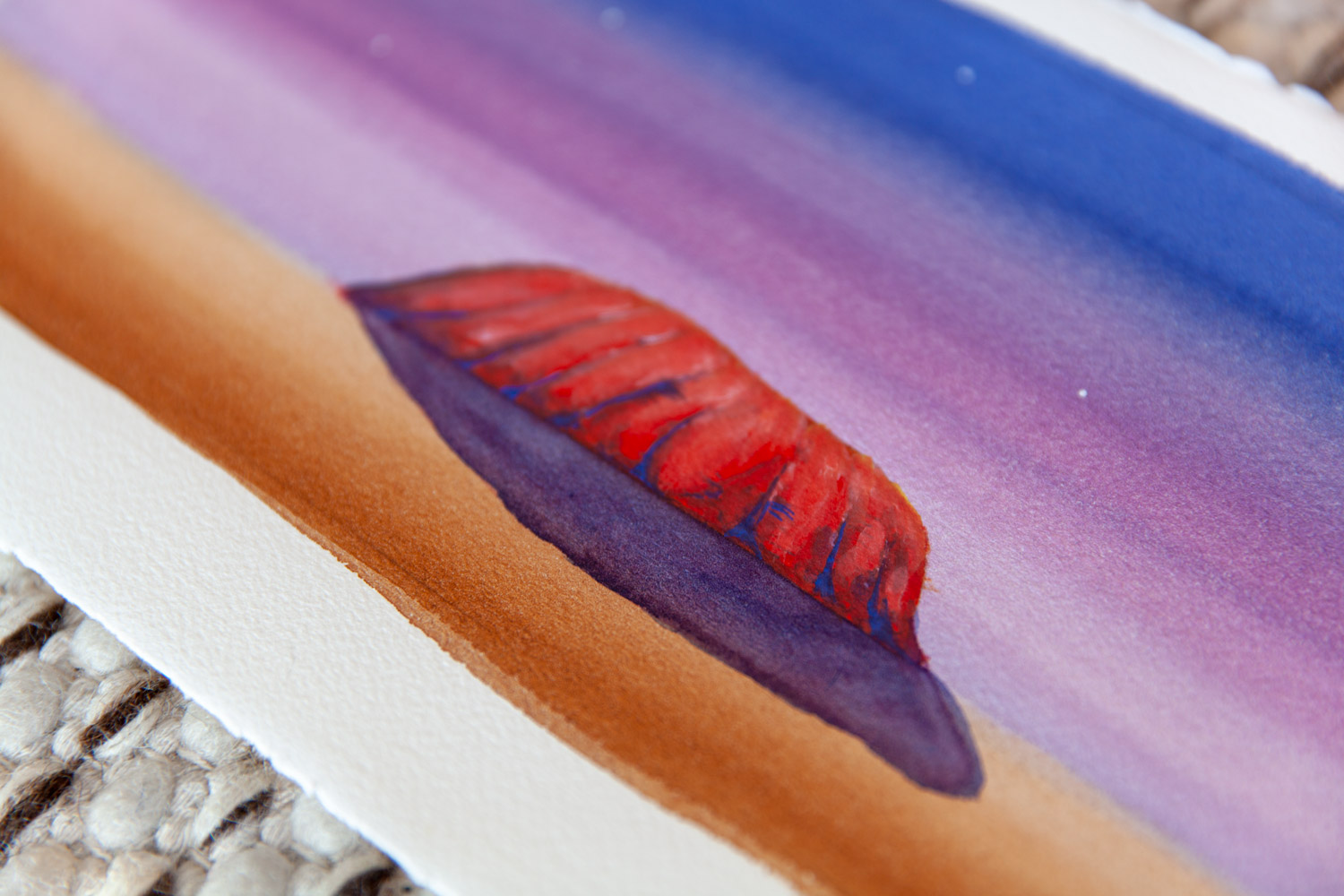
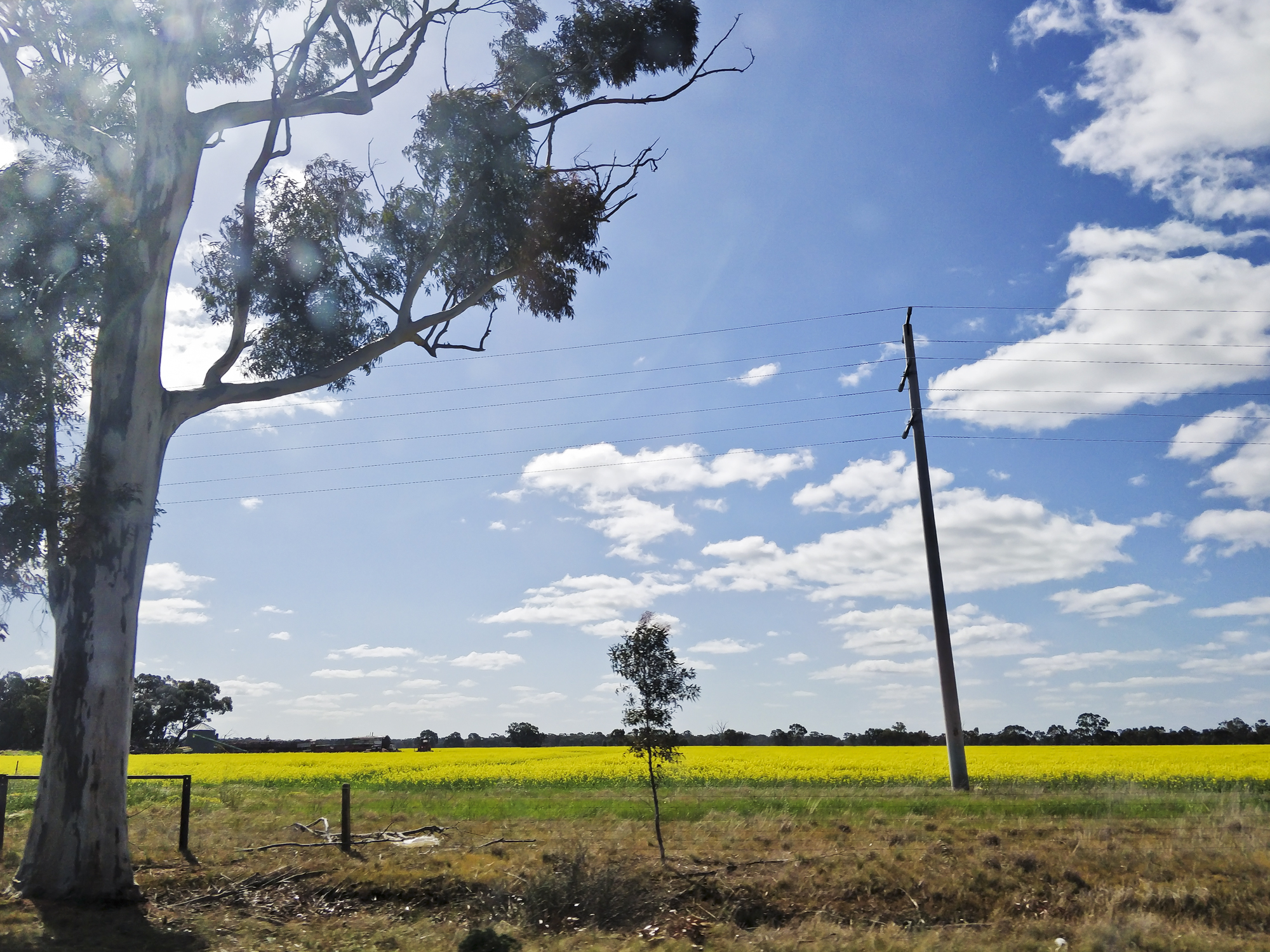
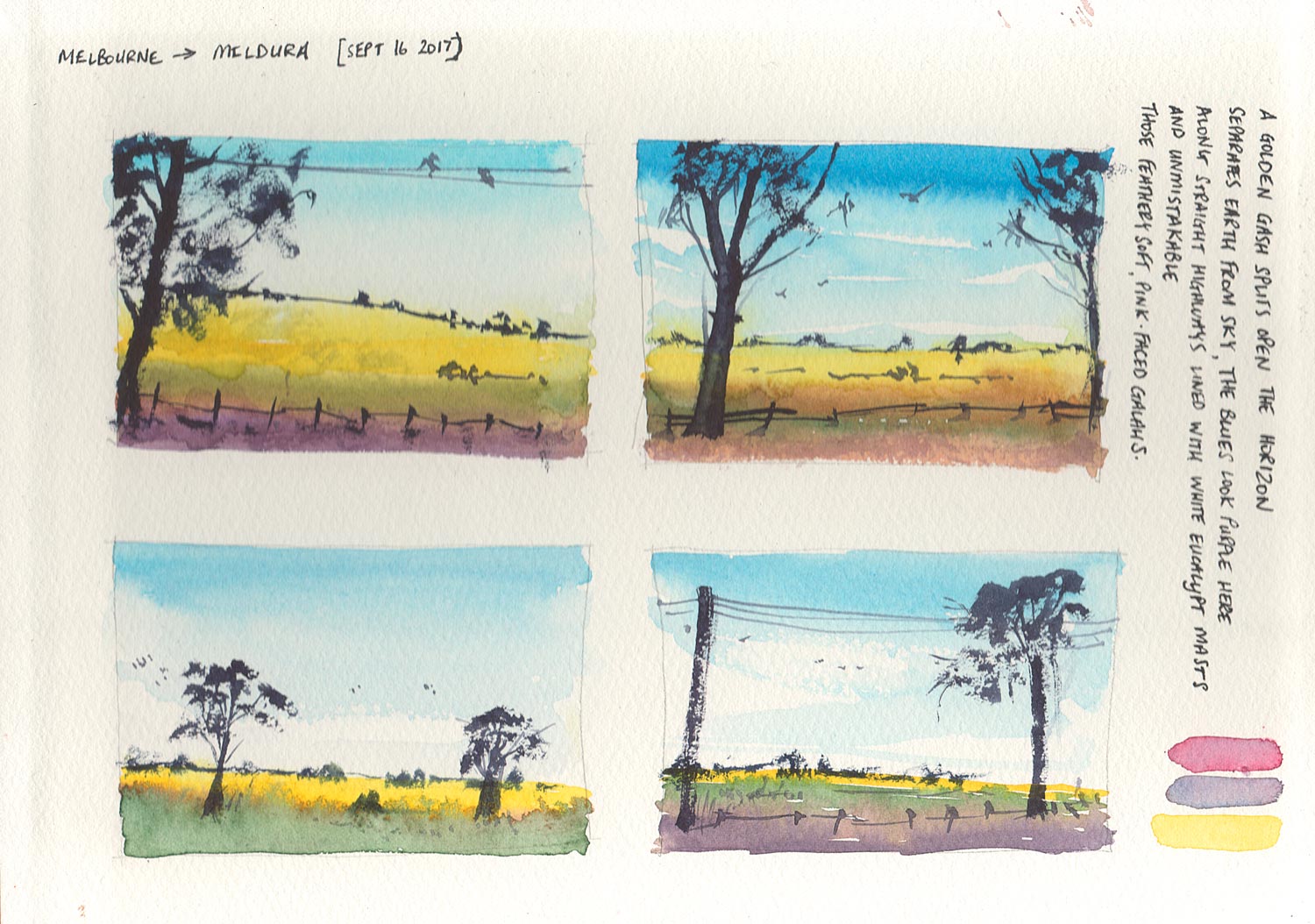
The canola fields on this drive are vast. I had no idea we ever produced so much of it.And, on a 6-hour drive, one has plenty of time to reflect. Often, these sorts of experiences produce words or images, not both. It goes to show how unique it is because colour and words washed over me like I never expected.
Word Sketch: Melbourne to Mildura
A golden gash splits open the horizon.
Separates earth from sky, the blues are purple here.
Along straight highways lined with white eucalypt masts
and unmistakable
those feathery soft, pink-faced galahs.
Mildura to Broken Hill
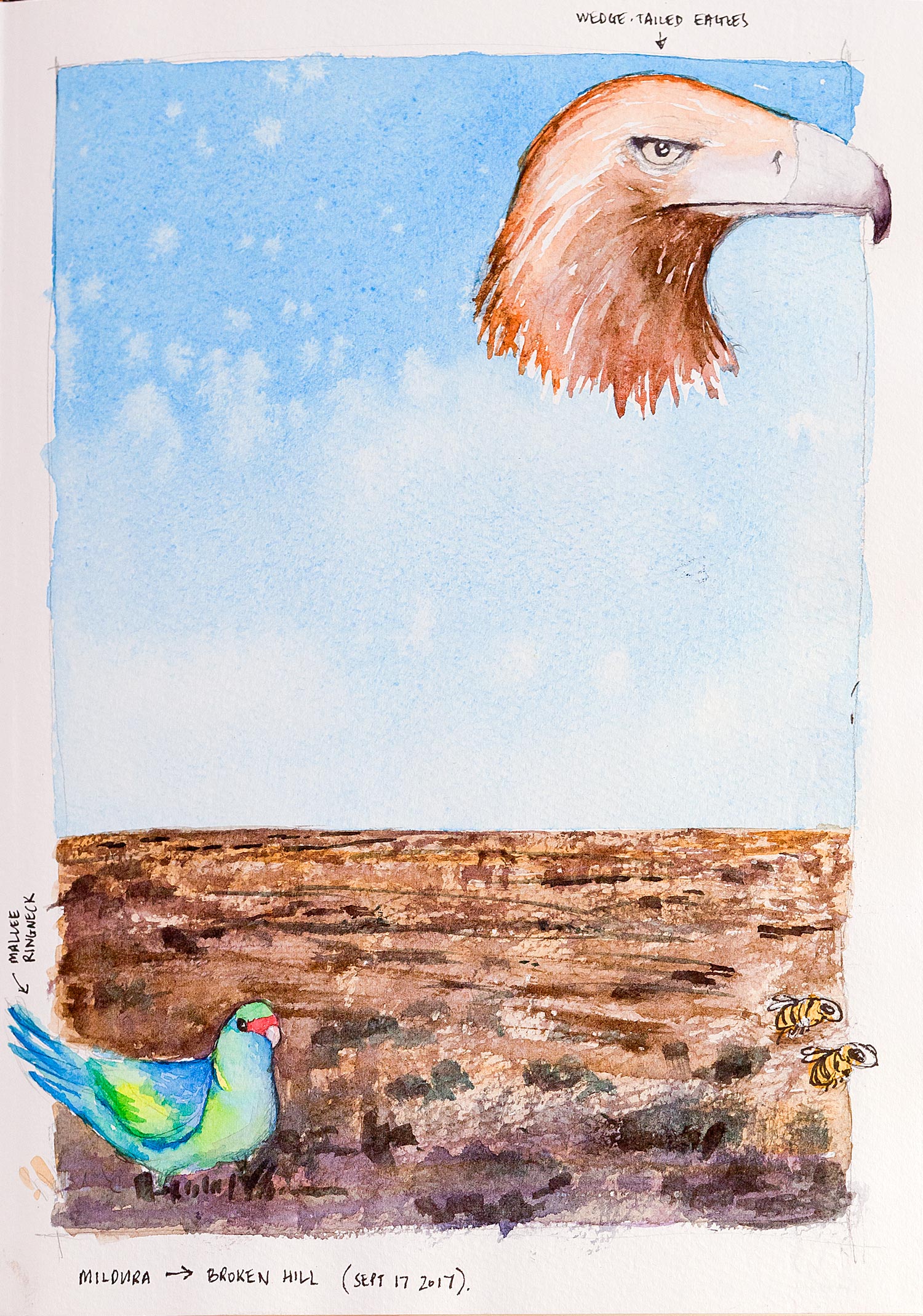
I’ve often heard that there’s ‘nothing’ between Mildura and Broken Hill. And, depending on how you look at it, you could be right. But even from a car travelling 120km an hour on a road as flat as a lizard snaking through the red dust, there’s plenty to see on this leg of the trip. The sketch is pretty raw, as sketches should be, but the majesty of the wedge-tailed eagle, and the vibrant colours of the ring-necked malee are enough to keep your eyes on the windows and not on the travel Guess-Who board game you brought along in case you got bored.
The wedge-tailed eagle rules the vast land out here. And the ringnecks stop for any puddle of water they can find (often under the public toilets). Oh and bees, did I mentioned the bees?
Broken Hill
I expected a lot of time to document the urban aspects of this lonely city in the middle of nowehere. But alas, we never had much time, and well, Broken Hill kind of knocked me for six.
I wandered the town with my family just for one day but the day felt like a dream, or nightmare, I still can’t decide. Broken Hill feels part dystopian landscape and part home. Obviously, it’s struggling economically having been built solely for the purpose of taking things out of the ground and selling them elsewhere. This town seems to have had ‘a’ heyday and you can see evidence of this in the gorgeous architecture that lines the main street. But the windows have for sale signs in them. Many are boarded up. It’s well and truly over now. In fact, the day we were there, the hot wind was howling which, I know, has coloured my experience of the place. I remember thinking that this was the closest I’d ever come to feeling a solar wind, it was that intense.
Word sketch: The man from Broken Hill
He says
the Mallee Ringneck is not from ‘round ‘ere
It’s too beautiful, must’ve escaped from a cage.
But between Oxide and Bromide Streets
windows are barred, and boarded.
They play two-up, but it only feels down;
One-up would do.
A festival of broken heels says it all.
But life above and below the hill still goes on.
Wind whips the dust up, hats off and
spirits down, for months on end.
The Mallee Ringneck escaped alright,
but he, no, he hasn’t found the exit
somewhere beyond Oxide and Bromide Street.
Maybe one day, he’ll dig himself out.
Anyway, Broken Hill came and went during the trip but it’s had a lasting impact on me, my view of Australia, and most importantly, my writing. In fact, shortly after this trip I completed my May Gibbs Creative Time Fellowship and wrote a complete first draft of a middle-grade fiction set in Broken Hill. So, if you’re a publisher reading this, get in touch and ask me about it. Trust me, it’s great.
Broken Hill to Alice Springs
Leaving Broken Hill was a bit of a relief at the time. But since I’ve left, I’ve learned more about the place, especially from Broken Hill natives, and I’d love to go back some day to explore, sketch, photograph it and also visit the surrounding areas.
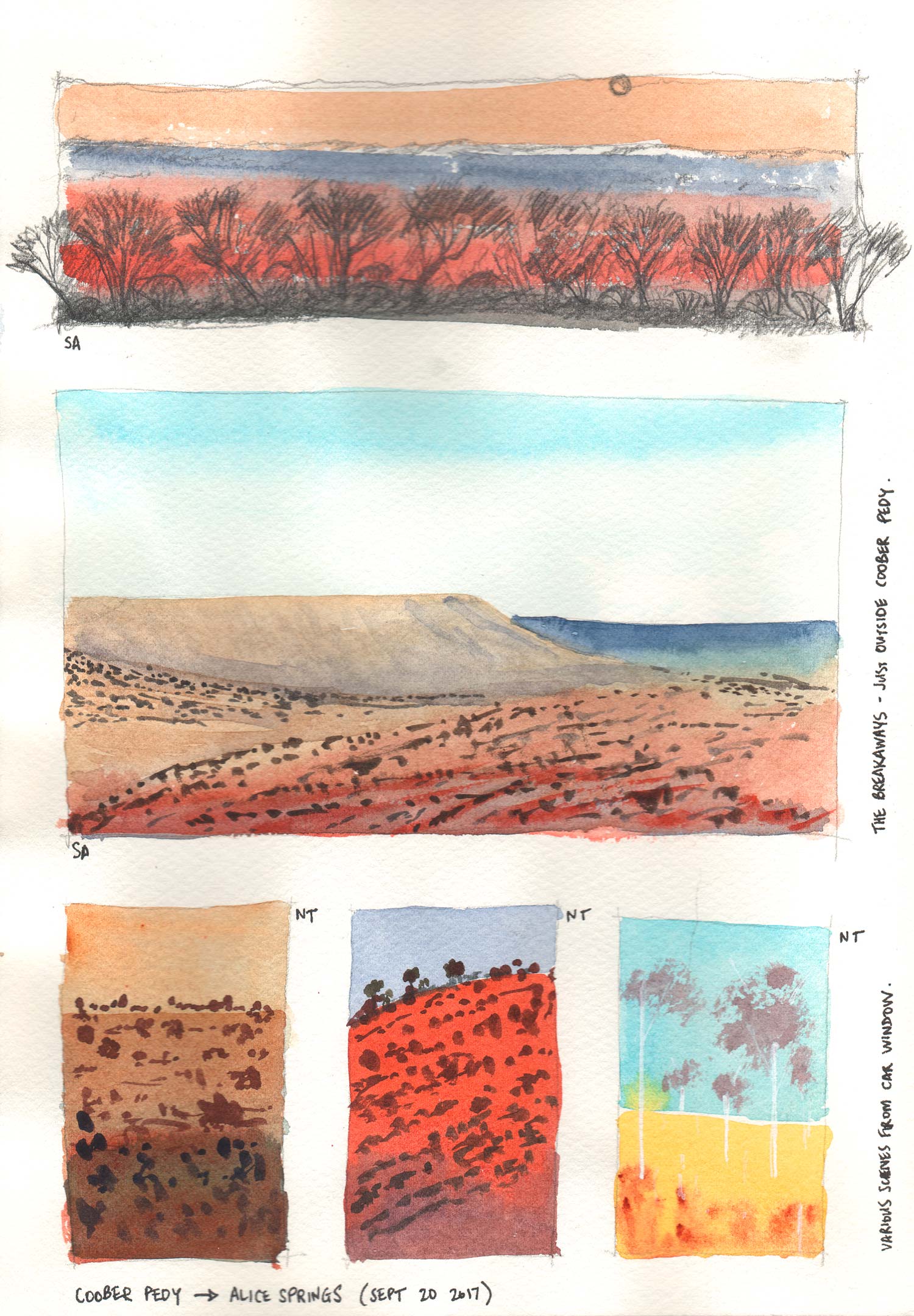
The trip onwards from Broken Hill to Alice Springs was a bit of blur. A blur of dust, tea and flies. Now, I’m aware that those three words don’t necessarily conjure an envious image but you know what, I loved every moment of it. I loved rolling into our motel for the evening in every place. I loved the surface-level ‘nothingness’ of all the bits in between. If you don’t know how full of life the desert really is, I can imagine you’d get little to nothing out of it except for maybe understanding the distances between these towns.
Word sketch: The recumbent cyclist
How ‘bout we cycle
Recumbently
From somewhere like Coober Pedy.
We’ll stop at a salt lake on the way,
Then we’ll keep on truckin’
Beneath birds of prey
And at Spud’s Roadhouse we’ll rest…
a cup of tea
And a wee.
Me? I was glued to the car window. I stared for hours at the desert and how it changed from cattle station to cattle station. The colours in some parts were vivid, and others more muted. It’s, quite simply, an assault on the senses. One year on and I’m still synthesising the experience. For now, these sketches will have to do.
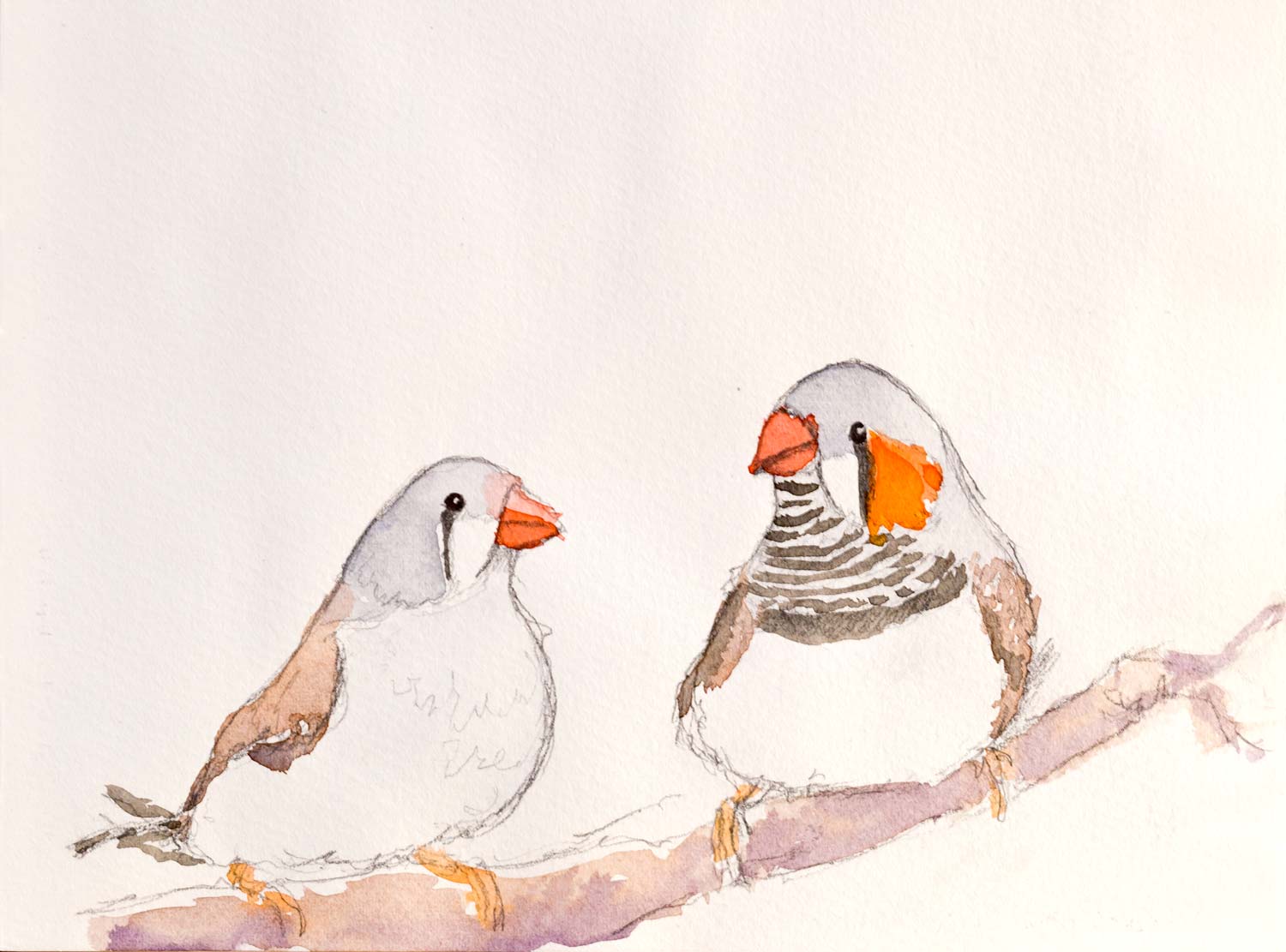
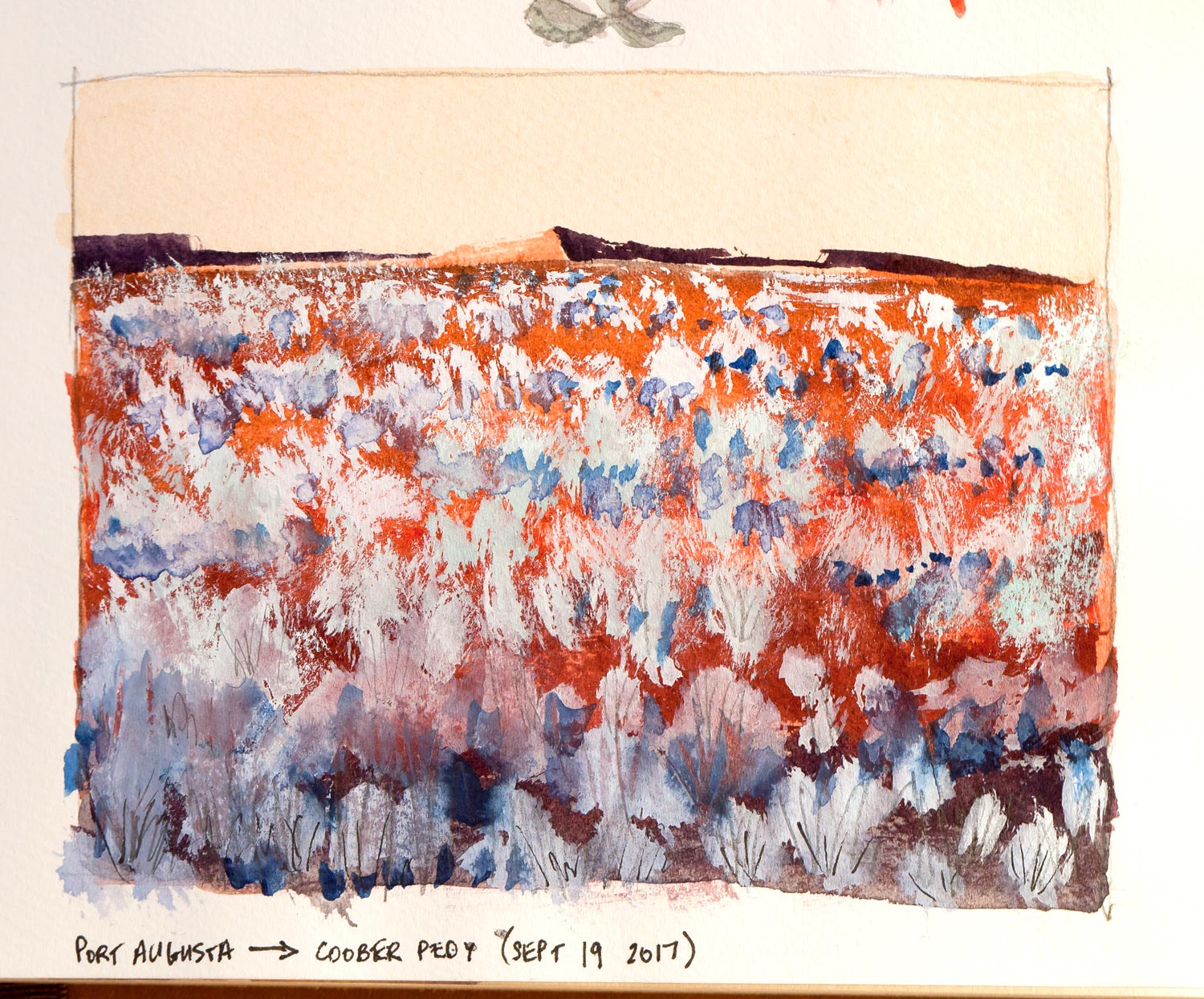
The landscape changes constantly on the long drive. I did my best to keep up. My goal was to document colours as best I could, for studio paintings I’d work up later.Zebra-finches: I was captivated. They honk like tiny geese. The aboriginal people used them to identify the existence of water in times of dryness. Ironic that I used water media to capture them I suppose.
Word sketch: The Ochre Pits
A ten thousand year old sunset
and sunrise
Baked in layers in earth.
Rivers ancient run
Past wattle and ghost gum.
Red cliffs tower and cool
The olive green watering hole.
And when the wind blows
in a brief and fleeting moment
A spirit carves a line through
the choir of zebra finches
and it’s still.
Here.
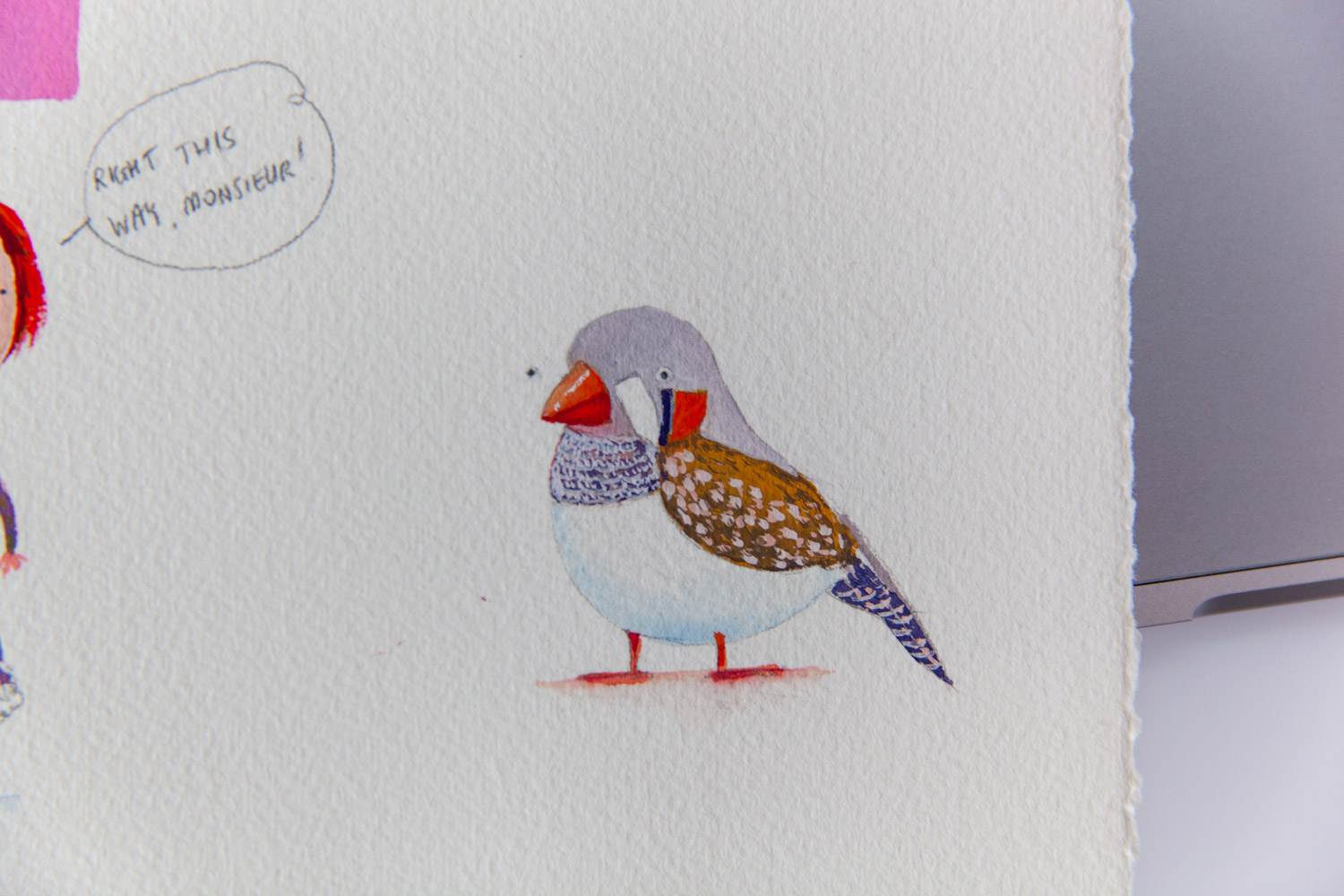
Back in the studio, I worked up this little guy from memory.Using gouache on location to capture the stunning silver foliage that thrives out here.
Uluru
I’m always torn between how I should be approaching breath-taking experiences and Uluru was no exception. I find myself grappling with the spiritual part of it; that documenting it is disrespectful in some way and maybe I should just sit and be still. I’m developing a reflex for capturing light these days. If I see something (anything) that gives me a little moment of wonder, I’m reaching for my sketchbook or my notebook to document it in either words or images. Uluru though, that was different.
Word sketch: West Macdonnell Ranges
From a thick red heart
Beats luminescent life.
In woodland,
sand land and river
The silver sparkle of
River and ghost
Fluoresce.
The heart still beats
And floods the country
Occasionally.
I mean, what an occasion.
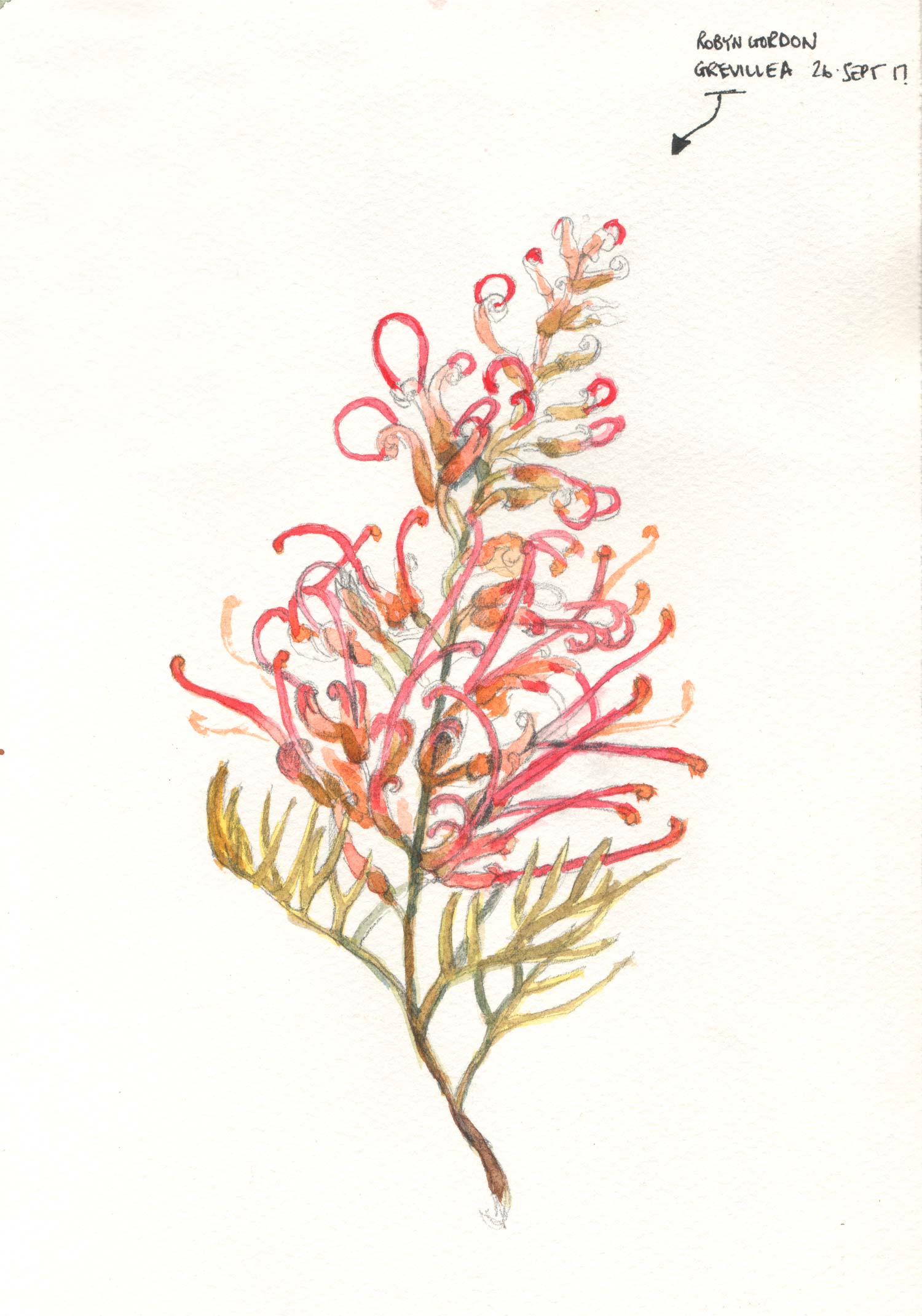
The Robyn Gordon Grevillea: Probably my favourite Grevillea. It’s such a show off! And they were everywhere.
I won’t wax lyrical about it here, perhaps another time, but it’s simply stunning. Our schedule had only two full days planned here, and I was getting a little itchy for some painting. But, when I sat in front of this sacred geological phenomenon, I stopped. I found that it had the same effect on me as trying to draw the inside of a church. It’s a sacred space to a group of people of which I’m not a member. As an outsider, should I be documenting this? I don’t see members of that group doing so. It makes me think.
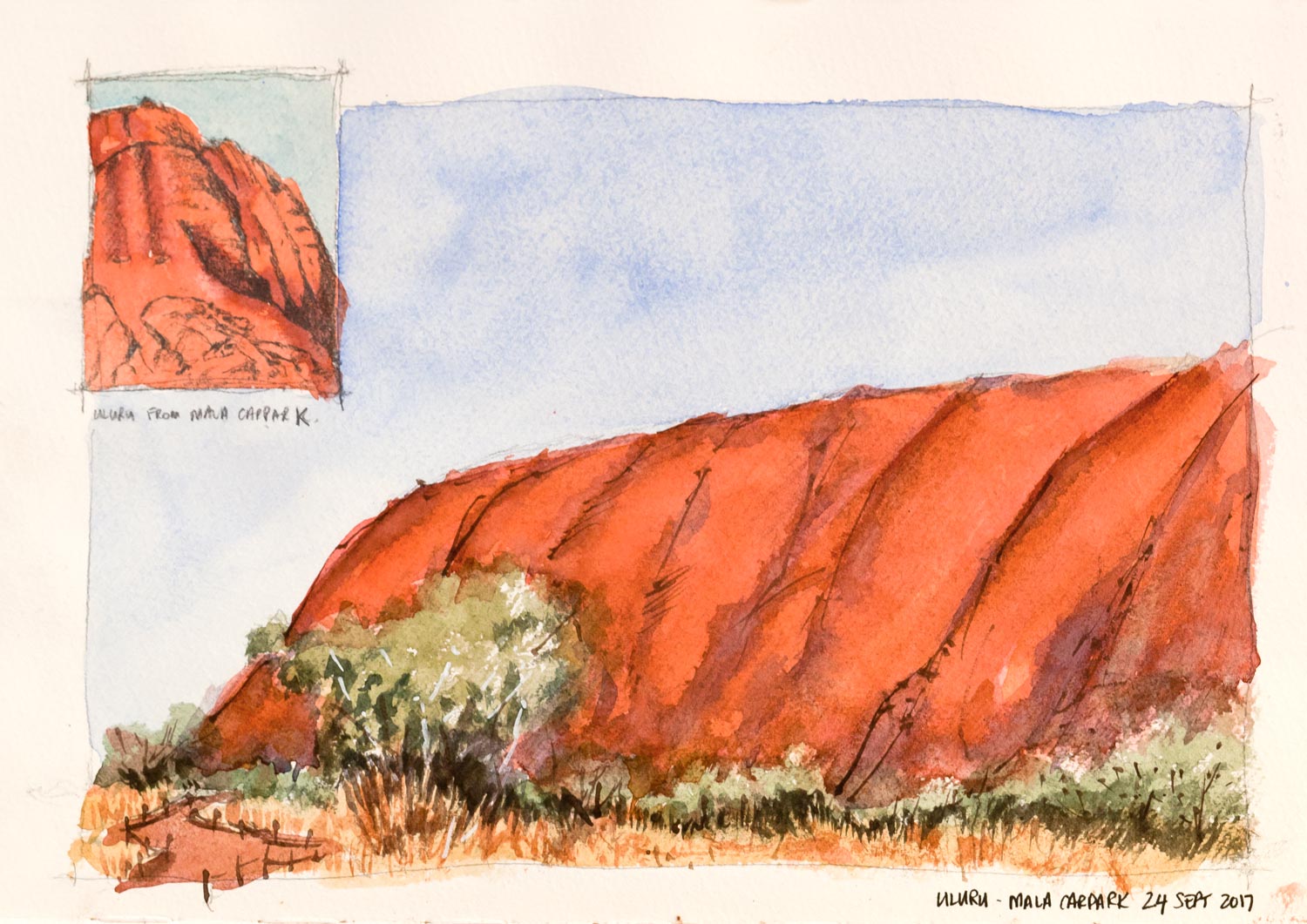
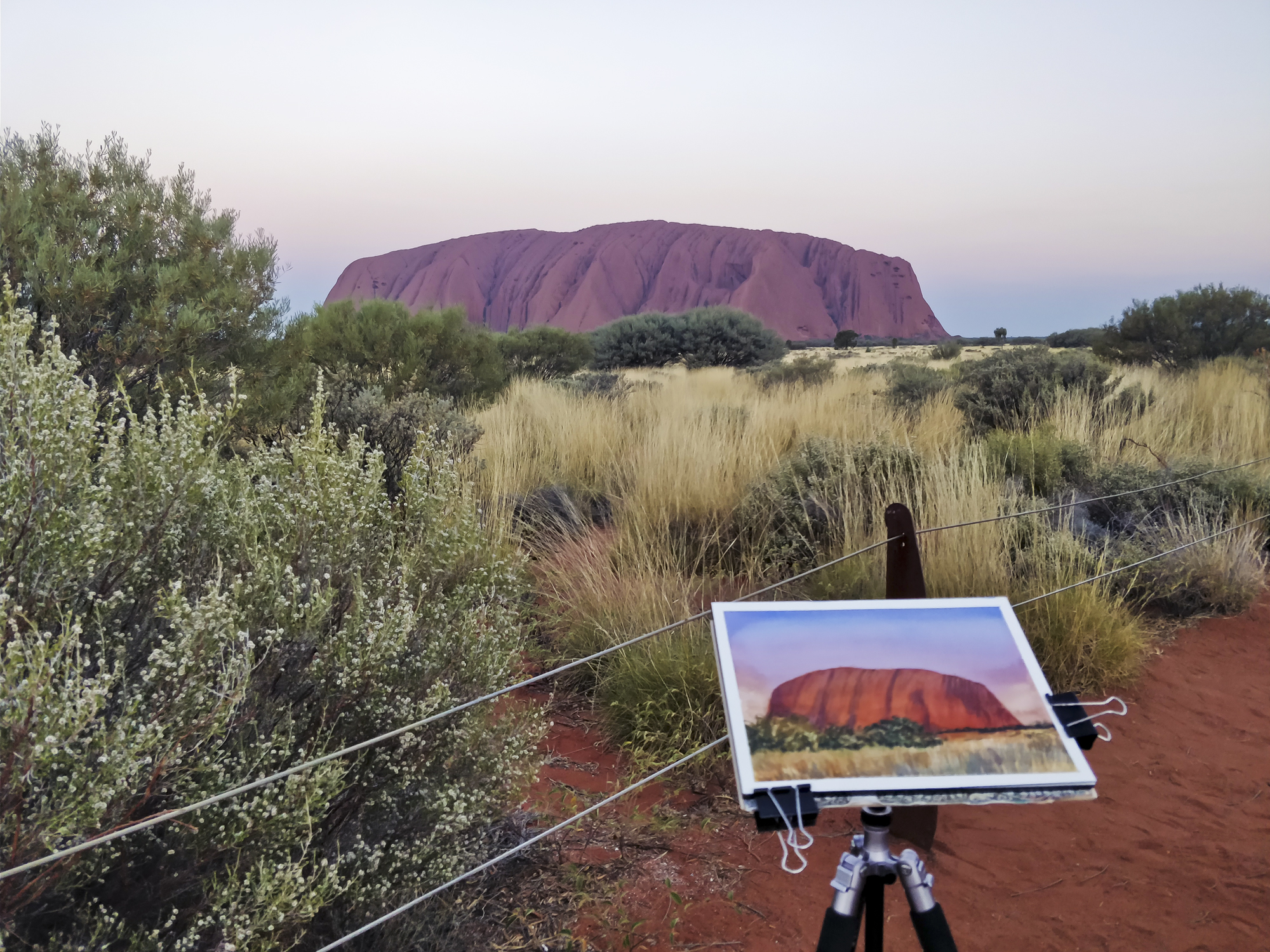
Anyway, I managed a couple of quick pencil sketches from the car park before we set off for a short guided tour around the rock. That was enough for day one. I finally got ‘used’ to being out there by the end of day two so I thought I’d take advantage of the stunning sunset colours and paint en-plein-air to really crown the trip.
Sketch from Mala Carpark: It’s surprisingly difficult to draw such a sacred thing, especially when you’re in its presence.
Word sketch: Uluru National Park
The two elders watch
and guard, safe keep.
They are not fussed
by the minutiae of millenia,
with groves of gums
and nectar-sweet grevillea
laid at their feet.
Their shadows, ultramarine,
cast visitors a momentary respite
and the wind rustles leaves,
an illusion of distant seas.
Palya.
Plein air painting: Uluru. The highlight of the trip.
Despite feeling a little strange in trying to capture Uluru in this way, I was reminded of the power of sketching outdoors. Within minutes of getting going, the kids crowded around and saw someone doing something artistic. Then, a few minutes after that, that same group of children set up camp around me with crayons, pencils and textas and proceeded to capture Uluru at sunset. It was a heart-warming experience, and one I’ll never forget.
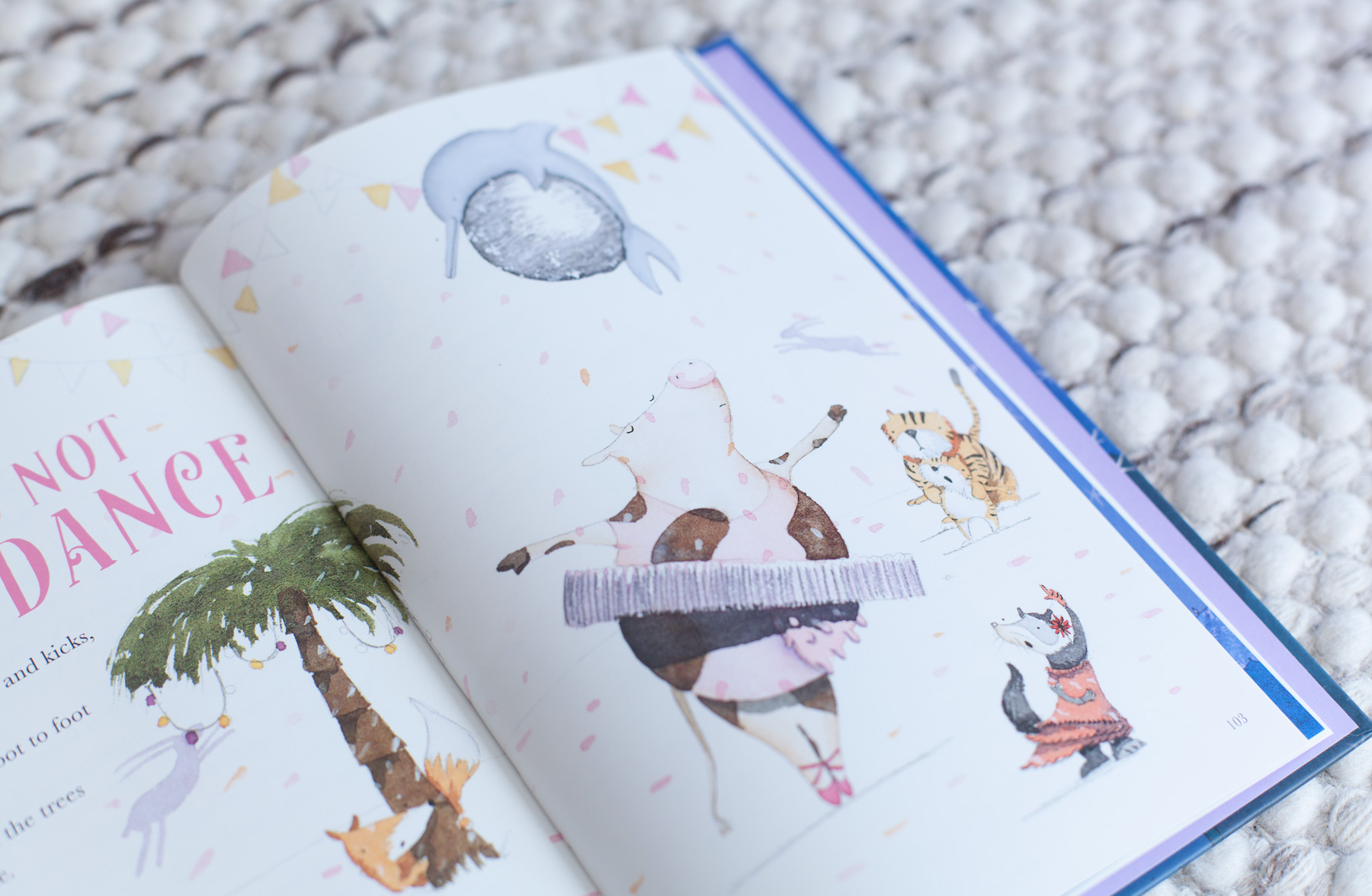
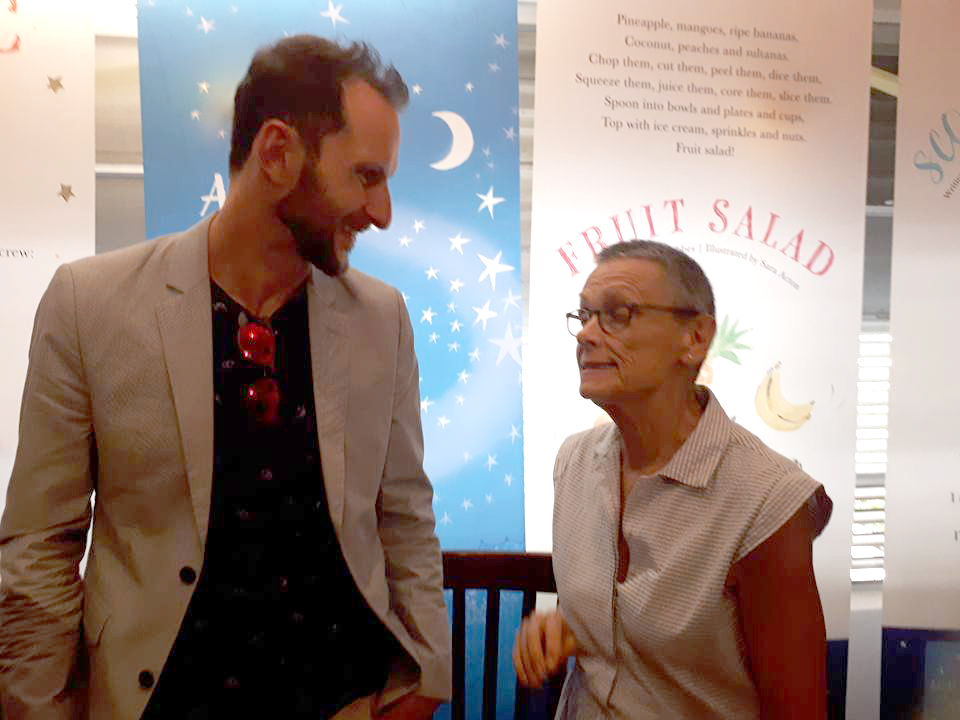
I recently met Julie Vivas at an event for a new collaboration I was part of, A Boat of Stars. I extended my shaking hand and was like, “OMG, I’m touching Julie Vivas!” Of course, I didn’t yell this at her but that’s what was going on in my brain. And so, remaining as cool as a cucumber on the outside, I introduced myself. Then, she said to me, “Matt, you have such movement in your work.”
And, in just those few words, she opened up a whole lotta internal questions about how I got to where I am, and my style.
Where did movement come from?
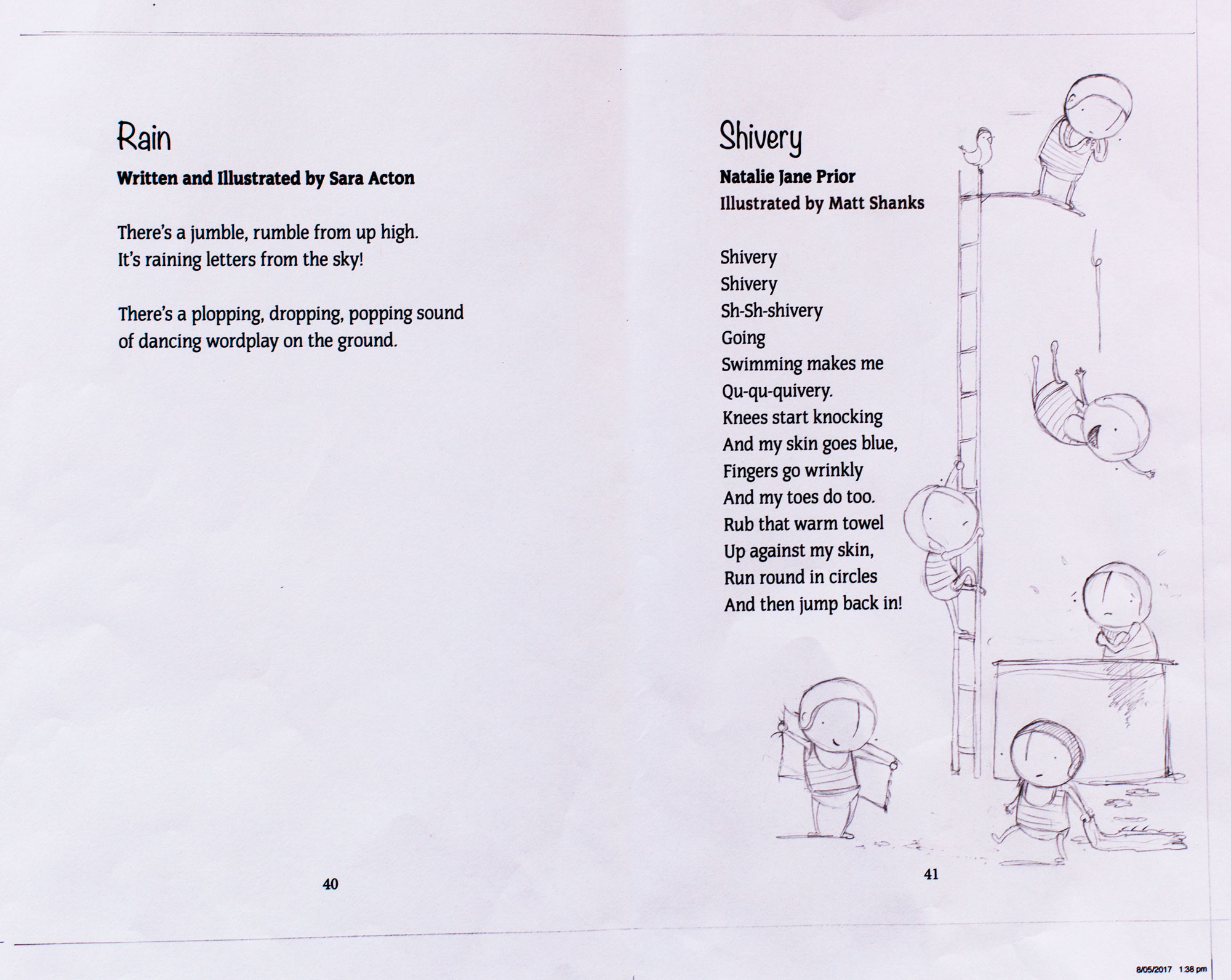
I’ve never thought about this, not one bit. At first, I didn’t even know what she meant. She pointed toward my illustration of “Shivery” in A Boat of Stars, and only then did I cotton on to her point. It got me wondering, I’ve never tried to get movement into my work. But there it was. So how could this be if it wasn’t intentional? So at the risk of reverse-engineering a completely false story, here goes.
Early sketches while trying to find ‘movement’ in ‘Shivery’ from A Boat of Stars
From about the age of 8, my parents filled every waking hour outside of school with Sport. I played golf, cricket, soccer and even dabbled in little athletics and tennis. Sport has been an integral part of my identity for years. Even today, whilst I rarely play anymore, I watch and support sporting teams in various codes.
So here’s what I think happened, growing up around sport meant that the body and its movements were seeping into my brain. They had to be, for sport’s sake at least. If I was going to tackle an oncoming player, I needed to anticipate which way the player was going to run? Where would the ball end up as it sailed out of the bowler’s hand and toward me at the other end with a bat in hand? All this is achieved intuitively by assessing the other player’s weight, body angles, speed, and direction of travel.
It’s not like I tried to consciously remember all the ways a body can move. I wasn’t sitting on the edge of a field documenting the impact of momentum and physics on our feeble squishy human frames. But, if we truly are a product of our experiences, my knowledge and interest in biomechanics must have come from somewhere, and this is the only reason I can find.
When I was in high school, my life in Sport almost influenced my decision to head down a path of a career in sports science. Biomechanics was really interesting to me; the fact that you could optimise tiny physical movements to produce greater efficiency was astounding, and it made total intuitive sense (this was despite my teacher at the time making fun of biomechanics as ‘nerdy’ and actively discouraging me away from it). But I was serious, I also had physiotherapy down as one of my preferences for university courses when I left school. It was only at the last minute that my curiosity around animation (which, as it turns out, is also the study of physics and movement) got the better of me, and I left high-school for a degree in Design Computing at the University of Sydney.
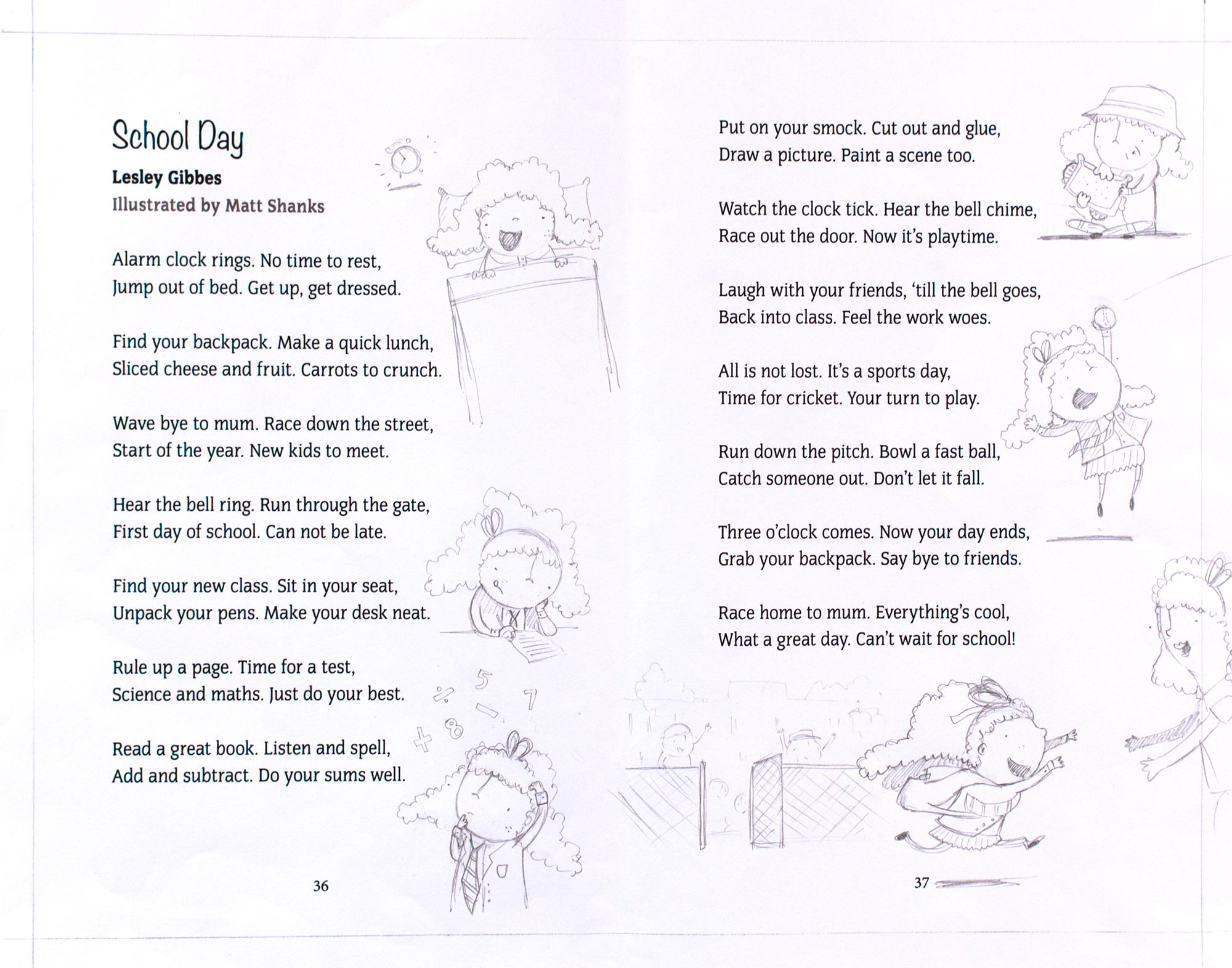
School Day from A Boat of Stars – loose clothing and flowing hair can also help illustrate movement.
Fast forward to 15 years later, and now I only watch sport instead of playing it but here I am telling a story about that time when Julie Vivas said, “Your work has a lot of movement”. I don’t even remember what I said in response! Probably something bumbling and stupid like, “Thank you, I loved Possum Magic. You’re the best!” But now, it seems obvious. I’ve lived a life where I’ve witnessed people in motion for 30 or so years. In the end, movement in my work? Well, it just makes sense.
We’re living in a quantitative world. No matter which social media platform you’re using, the numbers supposedly don’t lie. It’s how we measure our success. Every one of these platforms offers ‘analytics’. A way to track your success and effectiveness of what you’re posting. The problem is, the numbers they’re tracking (and giving us) are the ones important to their own success, not the success of the individual. After all, the assumption is that we all want to scale and grow everything, right? Just as a company would.
So, like I did, you spend your life trying to optimise; trying to bump up the numbers that they give you to play with. It goes a bit like this: Last time I posted a photo of my cat, I got ten extra followers, that’s more than any followers from any other post. So, now I post more pictures of cats. Right?
Well, yes, that logic is excellent if your goal is to increase followers or, as the businesses say, “To scale your business and become an influencer”, to “Build an audience”. But what if ‘scale’ isn’t your goal? Where are the dashboards and metrics that provide insight into the quality of the audience?
To be honest, I’m over it. I’m really tired of ‘building my audience’. I’ve spent the last five months not posting to Instagram at all. And, as I suspected, my follower count is dropping at a relatively steady rate. It’s Instagram’s way of saying, “Hey you! Don’t lose your followers! Come here! Keep posting. We need you!”
These platforms we use reward behaviour that they want us to perform, and as a by-product, subconsciously encourage us away from posting stuff that, quite possibly, is the real stuff people want to see; stuff that creates a raw and realistic picture of what life is really like. It might not necessarily be aspirational or dreamy. It’s probably the stuff that doesn’t make you feel ‘hashtag blessed’, or, worse yet, be algorithmically successful.
When I surveyed my mailing list, what was the number one thing people wanted to see? The mistakes I made. The crap work. The work that tells every other person that I’m a human that does 4000 versions of something I hate to find the 1 version of something that ends up in a picture book. In other words, they wanted to see the work that I feel too embarrassed to show and the work that will make my Instagram feed look like a car crash.
It’s time to dance to the beat of my own drum
Dance to the (algo)rhythm
I know what kind of posts Facebook rewards. I know what kind of posts Instagram rewards. I know what makes those little lines on all my dashboards tick upward letting me know that I’m doing a ‘good job’. Keep it all consistent. Keep it on-brand. Post regularly. Make sure people can glance at your feed and get an instant idea of what they’re signing up for. And I can play their game; these platforms aren’t that sophisticated. But now I’m thinking their game sucks, and it’s time to try something new.
Dancing to a different rhythm
I’ve recently been asking myself what’s truly important to me. What will bring me and my art practice the most significant rewards? I’m questioning whether the data that Twitter, Facebook and Instagram value as businesses are actually what I care about.
As it turns out, it’s not.
Ever since I started this crazy picture book journey, I’ve been interested in one main thing – making a positive impact in the world. So, with this lens, I’m now experimenting with setting my own metrics.
Exhibit A – My mailing list.
First, we shape the tools, and then the tools shape us.
I use MailChimp to send out a quarterly newsletter to those who like to hear from me about what I’ve been up to once every three months. And, like most people, I want to know whether the effort I put into them is worth it.
It usually takes me a few weeks, working an hour or two a week, to put one of these together. I try to keep the content of them relevant to what I think my audience wants to know. It’s highly visual and quite personal. Because it’s not a social feed, the rules are slightly different. The algorithms aren’t serving content, I am.
I’m one of those people who loves feedback. When I send out a newsletter into the big wide world I’m the guy who sits in the dashboard refreshing it every few minutes to see who’s opening it, what are they clicking on, when are they clicking on it. Here’s what Mailchimp thinks is important to me:
1. Open rate
2. Click rate (per unique open)
3. Audience change
4. Forwards
5. Last clicked
The list goes on.
So, when I first started, I had no idea what these numbers meant. On their own, they aren’t that useful. Then, after a while, I saw a trend. It looked like people click on listicles the most (articles that start with phrases like “10 tips for…”). Next most popular, images of art that aren’t mine. My open rate is higher on Tuesday mornings than it is on Thursday afternoons. My click rate is higher if I send out curated content I’ve found on the internet as opposed to links to my own stuff.
Huh. Interesting. But useful?
If I want to play the game that Mailchimp wants me to play, then great. I can change what and when I send emails out, and those numbers will definitely go up. But, at what cost? Do I end up becoming a ‘good curator of other people’s content’ for people who aren’t interested in me anyway? Is that what will help me become a better artist or teacher?
I know I’m taking a simplified and pessimistic view of this data. But bear with me a moment.
It comes back to what I really want to know; when I switch off the dashboards and insights and numbers and ask myself what I really want the answer becomes clear. What I want to know is whether I’m increasing my connection with my audience. I want to know how my content is making people feel. Do people care about what I’m telling them? Am I adding enough value into someone’s life to even bother doing this? And what value is it adding to mine?
So, I made a fresh start. I decided to make up my own set of metrics. Ones that I think give me a more explicit indication of whether what I’m doing is fulfilling the goals I want to achieve. These are metrics that no ‘service’ offer. It’s up to me to track them. So here they are:
Does anyone bother to reply? And if so, who?
How did it make them feel? Angry? Sad? Happy?
How does it make ME feel to receive each response.
When you start to consider these metrics before you create content, it’s surprising what sort of content it unlocks. Instead of posting highly visual photos of other people’s work (e.g. ten best social media artists to follow), I start to think about telling personal stories so people can get to know me better. Instead of posting pictures of cats, I think about telling people about the impact that their financial support is making in my life, and the lives of others through the charities I support.
It’s different. It’s not how Mailchimp or any e-marketing textbook would frame ‘success’, but it makes me feel really good.
Numbers Shnumbers
Whether Facebook, Instagram or Twitter or are doing it purposefully or not, the algorithms they’re using to serve content are rewarding behaviour that, in the end, gives *them* as much reward as possible – and that’s scale. The number of eyeballs on the platform is what’s important to them. And, just like billboards placed on highly used motorways, it means they can reach more people with advertising and therefore charge more money for that space.
No matter how sure I am about this decision to change what content I share in the world, I still have fear. I fear I’m about to ‘cannibalise’ my social media accounts. I’ve spent a good chunk of time building a pretty modest following, but I’m about to start posting things that probably won’t make the maximum number of people hit the like button or the follow button.
But I know that when I do feel that intense pressure that these platforms will put on me to influence what I post, I’ll return to this article and read me to myself. Hopefully, that’ll be enough because I’m not measuring success by analytics dashboards anymore.
I’m a self-taught professional artist. I’ve only just recently started saying that to myself, and it feels really good. I’m proud of it. I managed my way into an industry by taking a different path; one that’s far less trodden but more accessible than ever.
But.
I haven’t done ‘official’ training, and that still worries me. I often wonder what it would be like to go to Art School. It sounds romantic. And I know I’m a romantic at heart. How much would it amp up my current professional practice? I’d also be able to say, “I went to Art School.” That sounds so cool. Traditional. Legitimate. But it also looks really expensive. So I continue to ask myself, what would I learn there that I can’t use the internet for right now? Here’s what I’ve been thinking.
Art school for improving technical skills
Becoming a better draftsman can only really happen with practice. I know this intellectually. I draw a circle and it’s a bit wobbly. So, I’ll draw another; it comes out slightly better. If I draw one-thousand circles, the thousandth one will be pretty damn circular. The same principle of repetition and honing your hand-eye coordination goes for everything from circle drawing to drawing complex urban architecture or fluid figure representation with line and colour. Do I need an art school for this? Probably not. I just need to prioritise this practice in my daily life. It’s a war with Netflix, and I won’t let Netflix win.
The real way to improve is to practice (and avoid watching Netflix). I drew hundreds of rabbits, then I painted this one
Art school for “finding my voice”
Finding my voice. Now there’s another matter. Can art school help with this? What do I need to ‘find my voice’ anyway? Surely my voice is a combination of self-awareness and rigorous repetition. Finding my voice isn’t about technical execution, it’s about looking inward. It’s about slowing down and finding out what’s important to me. Asking myself big moral questions about my own place in the world and how those thoughts and feelings can manifest themselves in the physical form. These things seem to be at the core of an art practice. How does my bag of bones, bacteria, and brain interact with and relate to the complex ecosystem in which I live? How does the result of that exploration make me feel? What does it make me think? What do I want to tell others about? Does an art school curriculum help with that? I’m not convinced it does. I dare say that life (aka age), reserved time for introspection and critical reflection/meditation can provide a pretty well-rounded replacement. It has so far. I am where I am because of it.
Art school for community and critique
Of course, art school also offers a community. A group of peers, teachers and mentors who would provide me with feedback and insight to ‘progress’ toward finding ‘truth’ in my work. This sounds kind of useful. I value feedback more than anything, especially feedback delivered with a discerning and empathetic voice. But is the collective voice of the few who run the Art School better than the voices of 3.2 billion people that I can access for free on the internet? The law of averages suggests that 3.2 billion people would get pretty close to giving me decent third-party insight into my work.
Oh, nothing much, just picture book legend Julie Vivas and I at a book launch together
If I’m searching for community, is it possible to find a mentor, a group of fellow artists through an organisation like SCBWI at much smaller fees and greater control than picking an art school? I’m inclined to think so because I’ve done this. My community is building. The collaboration I have with my agent, wife, peers and publishers is a rich environment of expert input. I can feel it making my work better, and it’s providing a fire underneath me to explore new and interesting ideas all the time. That’s what art school is supposed to do, right?
Art school for availability and access to ‘resources’
I find it very difficult to imagine art school being able to provide a set of reading or visual references that I can’t find online. In Melbourne, there are several weekly life drawing classes, and they’re $15 per class, and include a beverage if you’re so inclined. There’s no long-term commitment. It’s pay as you go. The last one I went to had 30 people in it. I made friends and found some critics. It was fun and useful, way cheaper, and more flexible than any art school I’ve seen who offers this as part of their service.
The ease of access to books and suggested reading lists from other artists is longer and deeper than I will ever have the opportunity to explore in my entire life. Perhaps art school offers a level of curation that would help me focus? But if I know myself well, if I understand the questions I’m looking to answer, I can direct myself to discover the answers and find a more profound truth just as quickly (if not quicker) than art school could supposedly unlock. It would indeed be cheaper. But is it $20,000 faster? I doubt it.
Art school for professional connections
Professional connections are probably another thing that art school would be good for. But then again, LinkedIn is pretty useful for that too. And besides that, I’m already working. Since my journey as a professional artist began, I’ve met so many other publishers and practising artists. There are industry events that don’t require you to be a member of any art school. You just pay to attend. And again, the fees are much smaller than any art school, and if you’re having a lean month, you don’t need to go. You can spend time drawing circles instead.
If I needed to access artists who aren’t on LinkedIn or don’t attend industry events, then they’re just an email away. Yes, many of them are too busy with their art practice to reply to my email, that’s true. But I’ve found incredible success by making sure my emails are focussed with razor-sharp questions, specific to the person I’m asking, that take no longer than 5 minutes to answer and are awash with gratitude.
With direct access to thousands of artists across the internet, even if only half of them replied, that still puts my access into the hundreds. In fact, I’ve tried this, and I’ve found so many of them to be exceedingly generous with their time, so the hit rate is still better than 50%.
So, Art School?
So I sit back having externalised my thoughts to realise that, in fact, perhaps Art School is still a tradition that I want to be a part of. As I said, it’s romantic, and there’s a history behind the brand names like VCA that still linger in my mind as having deep industry value. But in the end, when I’m clear about what I want to get out of Art School, the rational part of me can’t seem to justify it. At least, not now anyway. Maybe I’ll end up with one of those honorary degrees one day. That’d be cool.
For all of the problems that a more globalised world has created, there’s one thing that’s clear in my mind – there’s never been a better time to be a self-taught artist. In fact, there may no longer be any value in distinguishing between self-taught and, well, whatever the other one is.
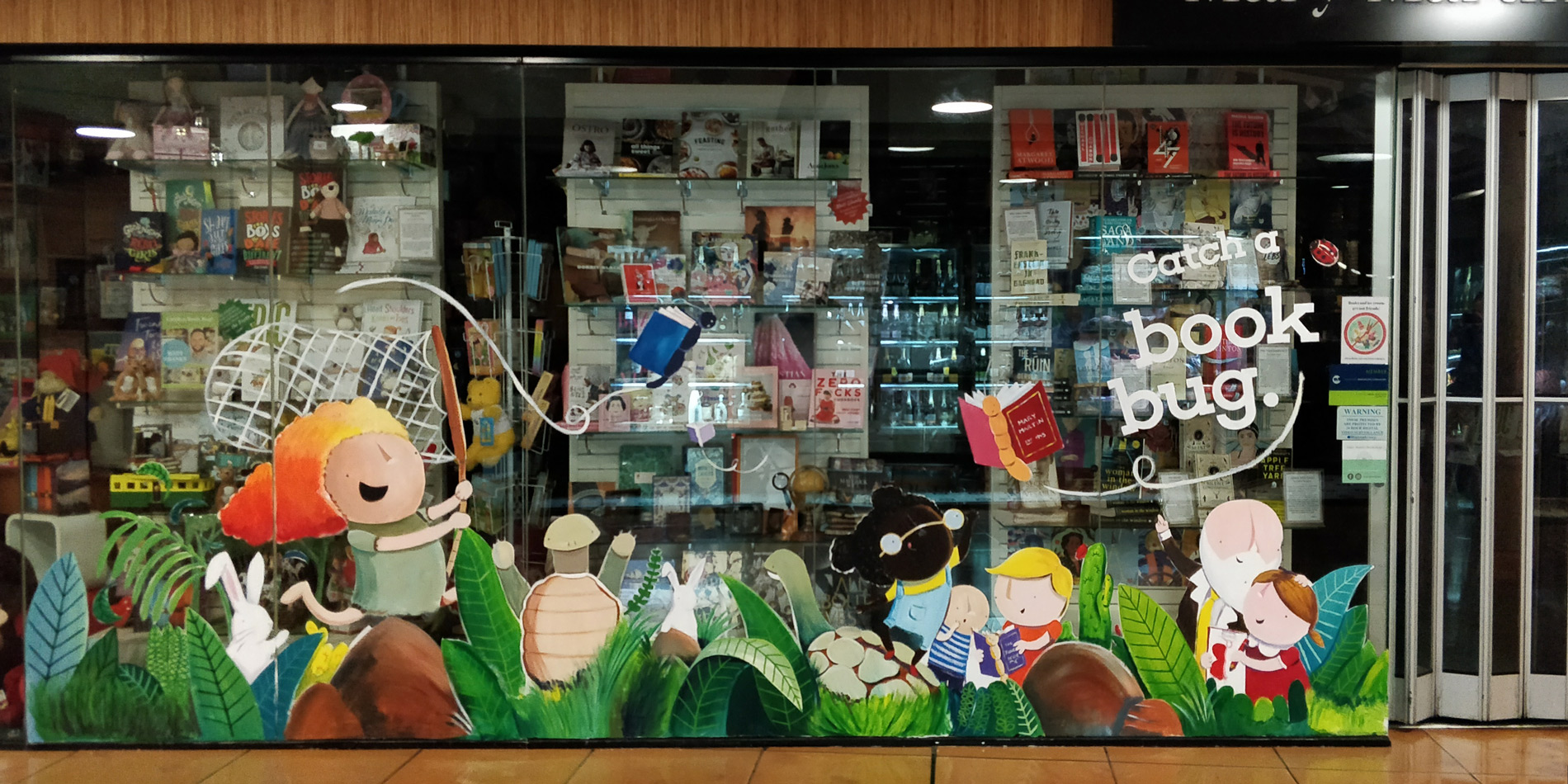
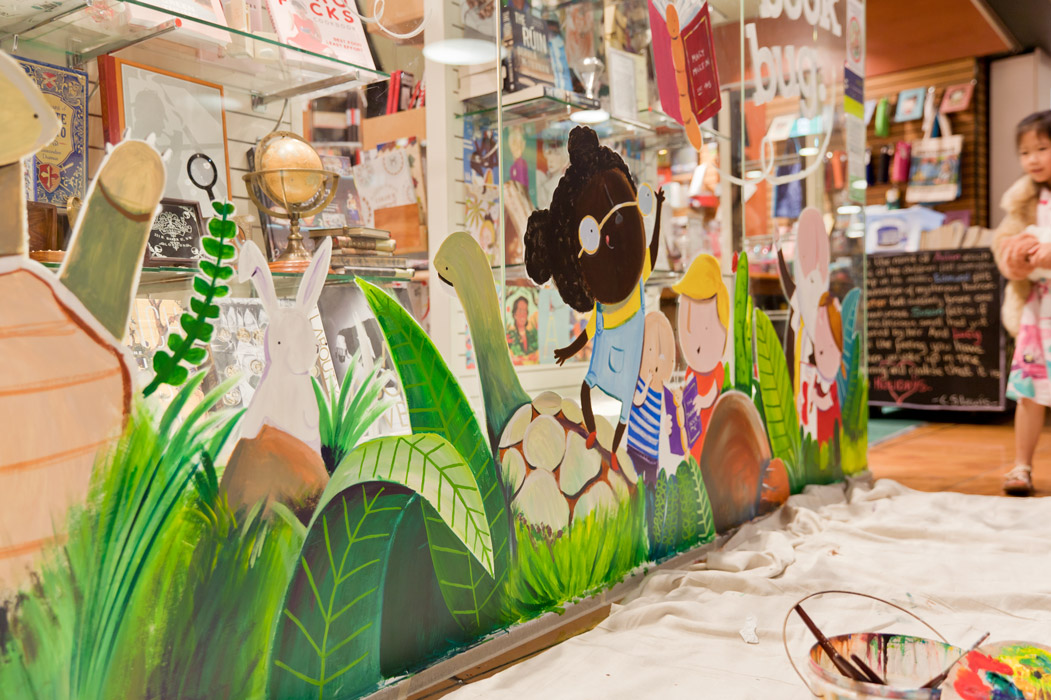
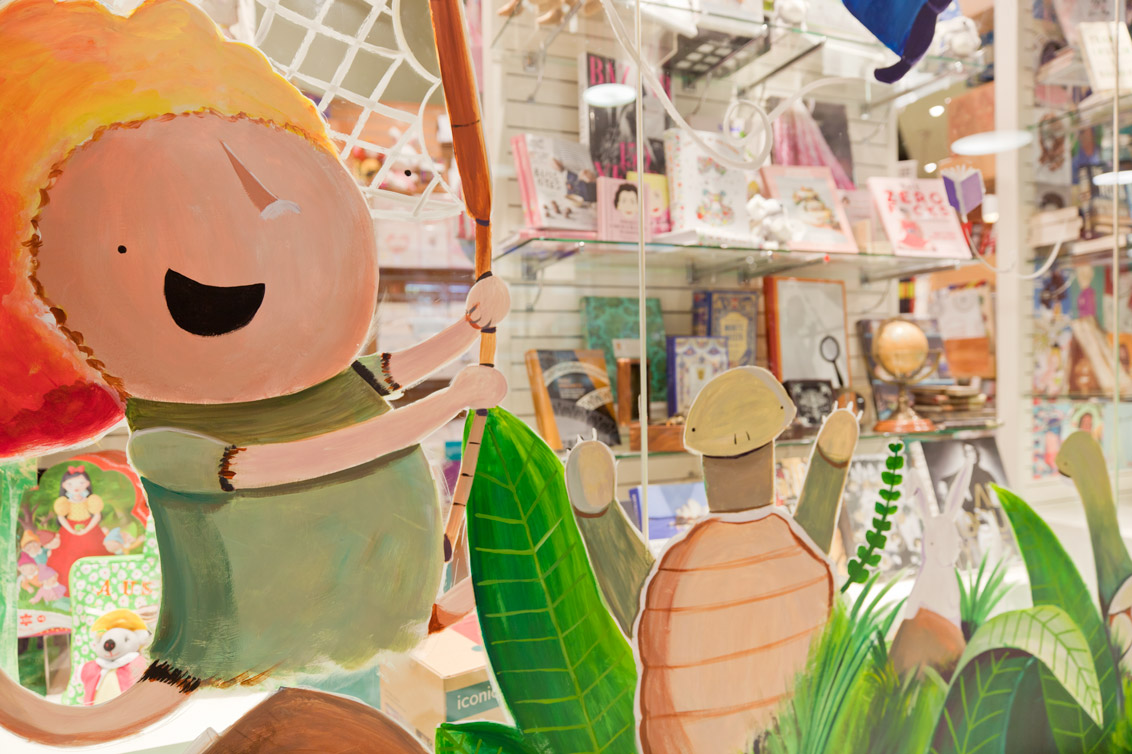
Having completed my first five-metre mural on glass, I wanted to share this little how-to guide to help other artist and illustrators shortcut the process if they ever want to try this themselves. At the time, I found it very difficult to piece together disparate pieces of information across the internet on how to do this to a professional level, but in the end, it turned out OK. So, here it is.
Drawing skills
This guide doesn’t cover drawing skills. I’m assuming that if you’re trying this, you’re at least confident in your drawing style. No matter how specific I can be about the application of paint on glass, nothing will make up for a wonky-looking drawing. How do you get better at drawing? Well, draw. Lots.
Materials
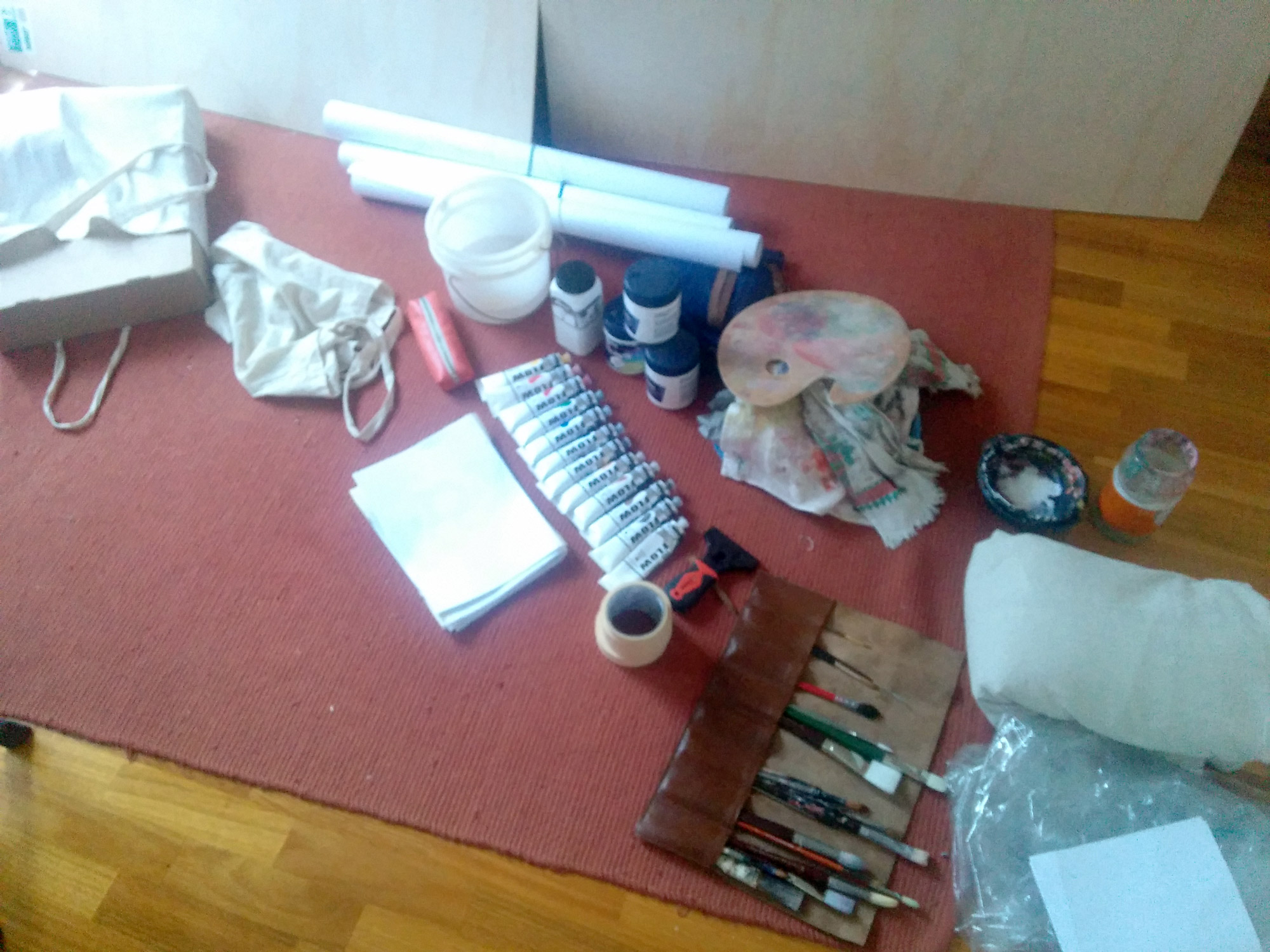
High-quality acrylic paint. Not too stiff, not too flowy. I tried a few and settled on Matisse Acrylic Flow. Large brushes and small brushes, paint pots, paint palette, drop sheet, music, a comfy pillow, pencils, glass pencils, windex, some rags, large sheets of paper, some plywood to practice on, posca markers, a four-inch razor for removal and trimming.
A very early morning photo of all the materials ready to be packed in to the car
Step 1: The idea
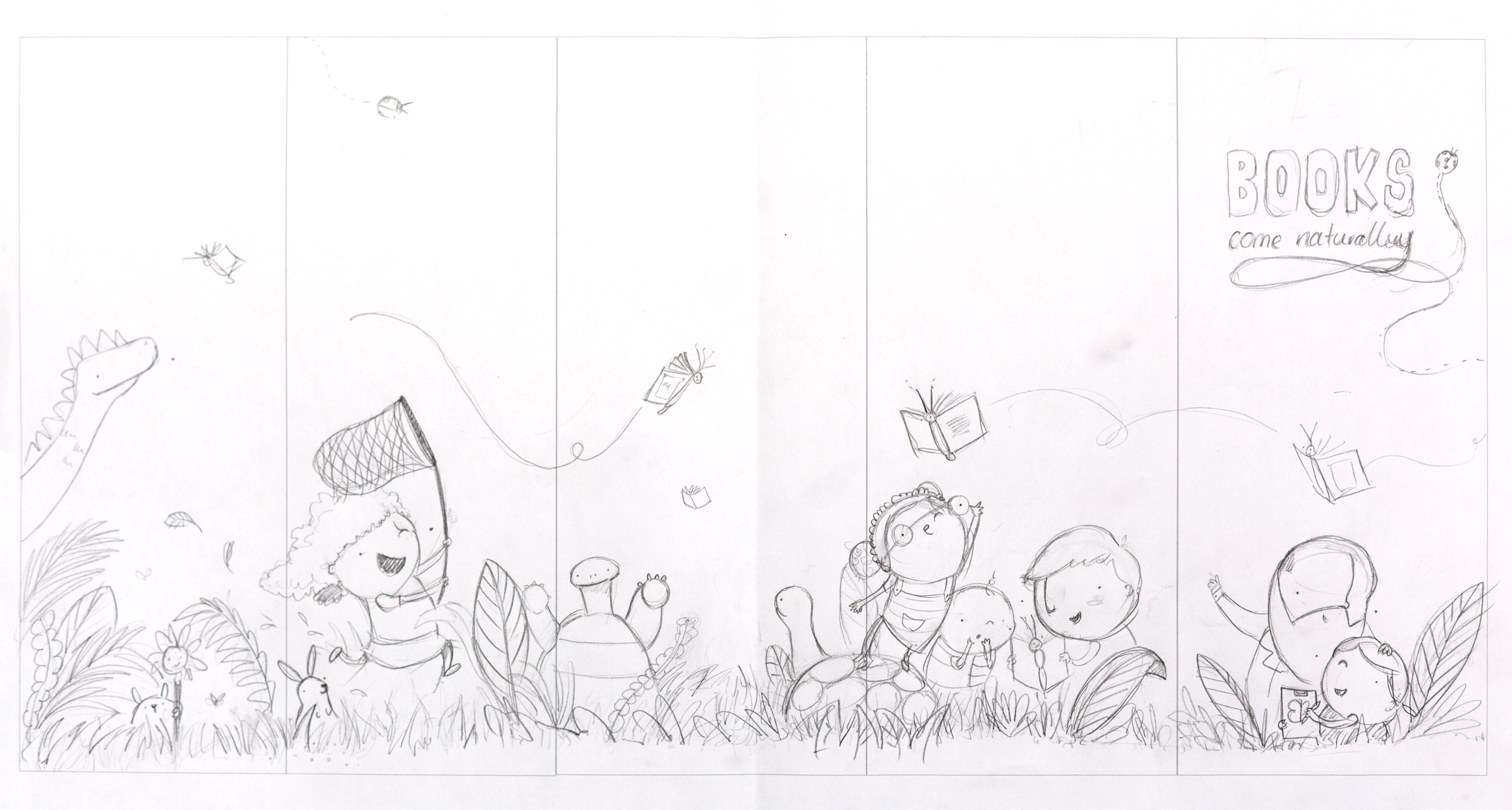
The original pencil sketch of the idea that later became, “Catch a book bug.”
Every successful project starts with the idea. No matter how good your technical ability is, if you don’t have an idea with clear intent, your project will be a house of cards. For the Mary Martin window, I started by sketching at a small scale. In fact, precisely 1:25 scale. I made a template of the window panes using InDesign (but you can use any software) and printed them out so they’d fit on an A3 piece of paper. I had the freedom to focus on the concept and composition at a size I was familiar with first.
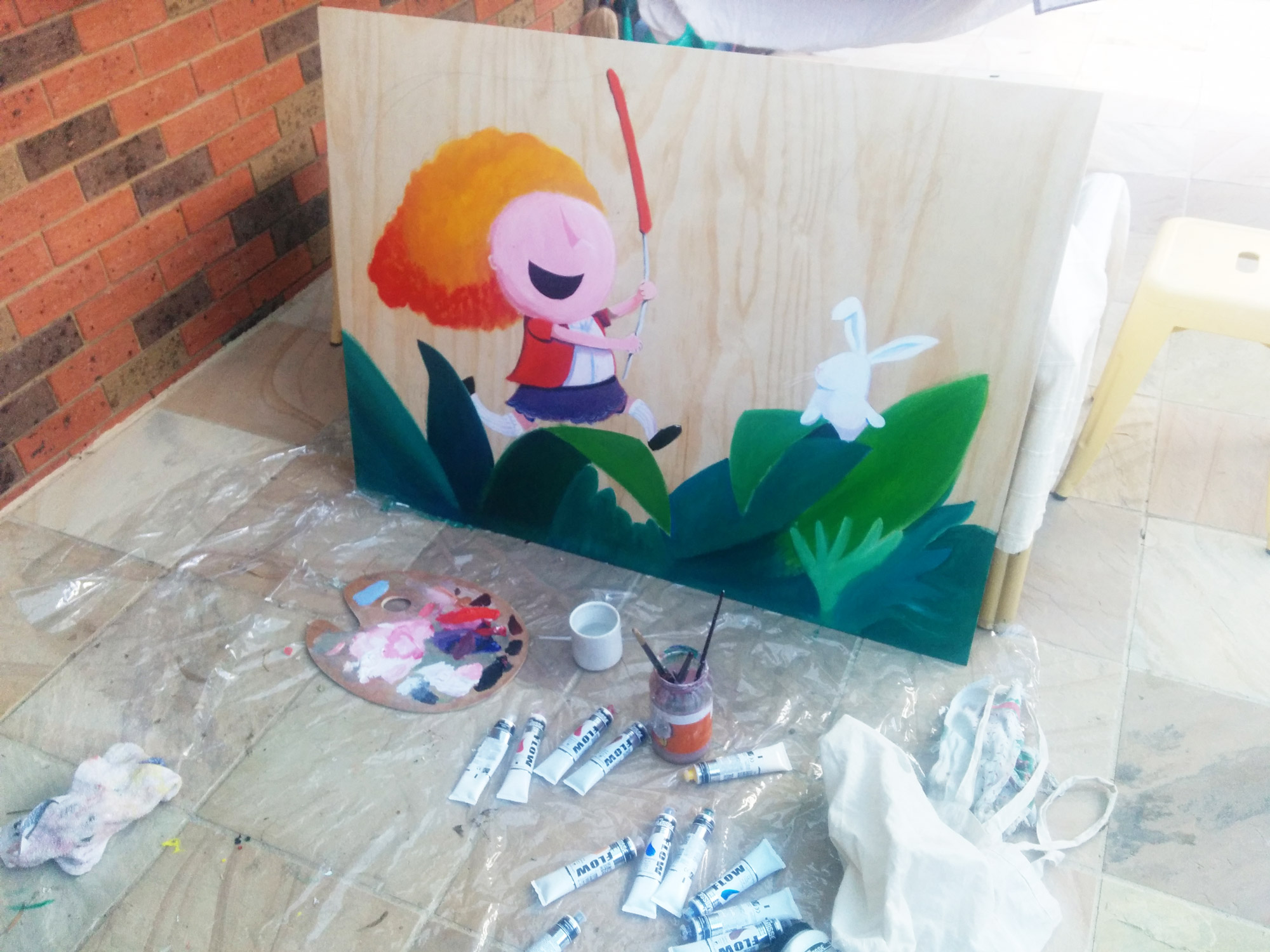
Scaling up, trying to paint on cheap plywood from Bunnings
Having only ever painted for picture books, blowing up my artwork to something like 5m long is a bit intimidating, so I knew the only way to do it was to practice. I know my ‘style’ intimately now so I know when something looks ‘right’, and when it doesn’t.
I bought a couple of large plywood sheets from Bunnings (1m x 2m) for about $10 each. Then, armed with a few dull old 2B pencils, a regular eraser and the idea, I started to sketch big. I didn’t try to replicate the whole mural, that’s far too intimidating, and it would’ve taken ages for me to get some feedback for my efforts. That’s the most important thing at this stage, finding the fastest path to getting feedback so you can learn quickly; it’s a chance for me to assess progress against what I was trying to achieve.
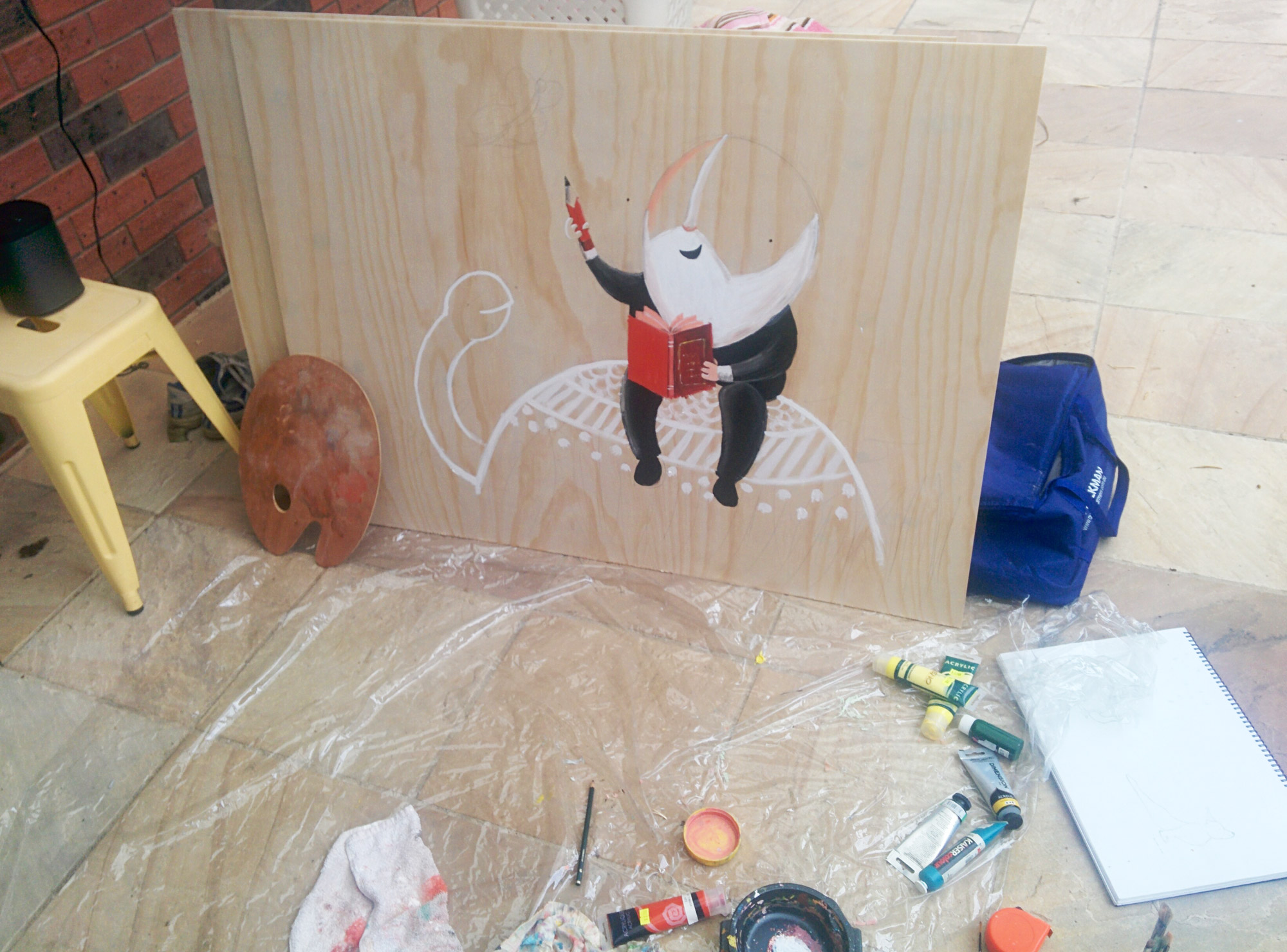
Using my original sketch as a guide, I redrew the character on the wall at scale
I focused one or two characters first and tried to replicate them as accurately as possible. The basic idea behind this approach was to train my muscle memory to adapt to the scale. I needed to “feel” what a good circle was like. Exactly how much should I be moving my wrist in the process? (The answer is not much). Things like eye-placement, body position and facial expression are core components of my characters, so I focussed on getting these correct first. I worked close, then stepped back a metre or two to see how it looked at a distance that people would typically pass by it.
Step 3: Acrylics
Colour mixing
Before this mural, I had never painted with acrylics. I went to the art store and selected a bare minimum of paints. I was familiar with working with a split-primary palette from watercolour, so I picked the same colours. How did I know they were the same colours? I ignored the sexy names they give them like, “Sunset Yellow” and just made sure the pigment numbers matched up. More on pigment numbers and how to choose colours.
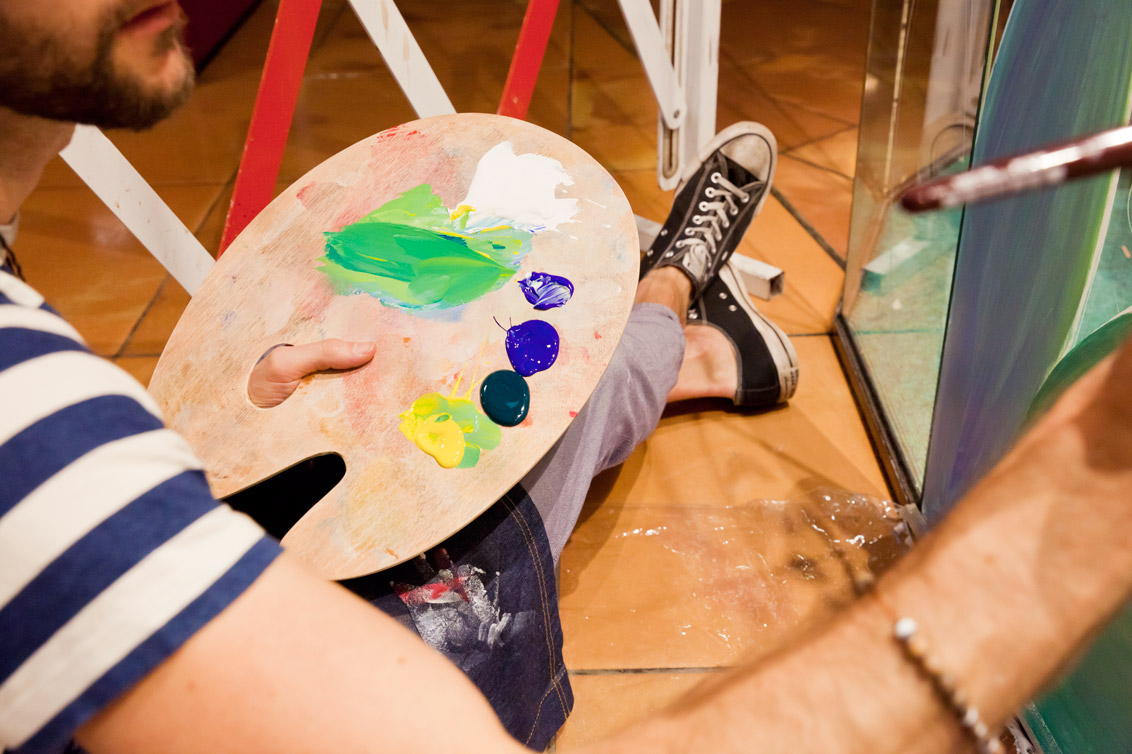
I used my plywood sketches and followed the colour mixing principles I’d developed for watercolour to start to mix familiar colours. Skin tone, Hair etc. Because I use water in watercolour to make things lighter, I had to get become familiar with adding white in acrylic to make things lighter. Hot tip: By LOADS of white.
Colour mixing rules are the same in any medium (which makes it rather convenient to save money on paints)
Applying acrylic paint on different surfaces
Painting on plywood and painting on glass are two VERY different things. Plywood is rougher and more absorbent than glass so as I was training myself on Plywood I started to worry that I didn’t have the physical strength to paint something that was five metres long. After a session or two on the ply, my shoulder started to ache. However, I persisted with getting a feel for mixing and applying acrylics to these two pieces of ply. I focussed on blending colours on the ply to make smooth gradients. I was trying to mimic watercolour washes, albeit with difficulty.
I began to understand overpainting and underpainting techniques and drying times depending on how warm the weather was. How much paint to use and mix on the palette, how much coverage I would get, and how transparent and opaque colours interacted with each other. I found the amount of information that seeped into my brain in 2 four-hour sessions was incredible.
One is a fluke, but two characters at scale is less of a fluke
Painting acrylics on glass
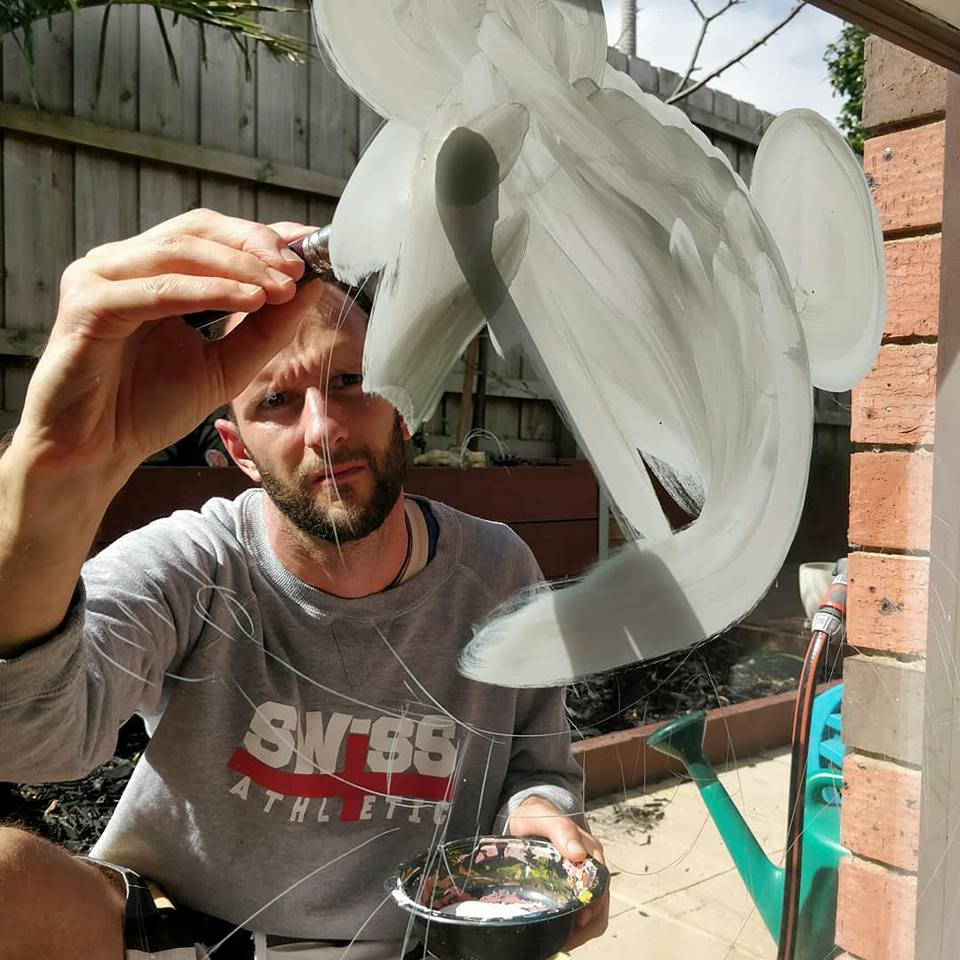
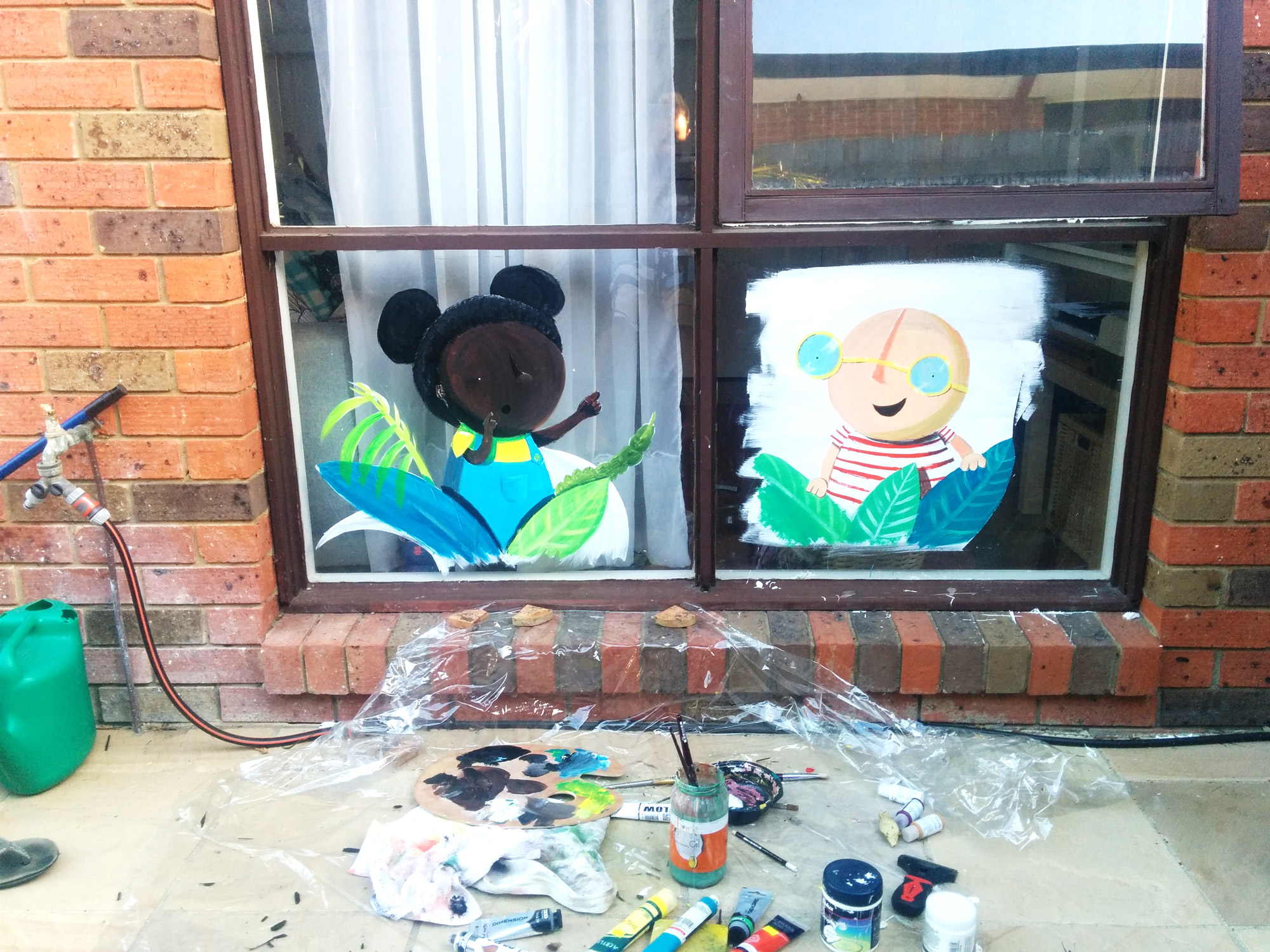
Once I started to become partially comfortable with the application of acrylics on plywood, I was ready to move to the glass. I thought about ways in which I could get my hands on some cheap glass (cheap glass seems to be an oxymoron), and in the end, the easiest, most affordable, and the most convenient way was to use my home windows. With the permission of my partner of course.
I needed to find cheap glass: turns out my house has plenty of windows!
Thanks to a few YouTube clips and some home practice, here are a few things to know before you start painting on glass:
The direction of light is critical. You need to understand which side of the glass is getting the most light. Shop windows are generally quite dark indoors which means that when you paint on them and walk past it on the street, you see far less streaking in your paint application. But, like Mary Martin’s window display, sometimes there is lighting just inside the window to light up the display. If the light inside is stronger than the light coming from outside, you get HORRIBLE streaking.
Lay down white first, as a base coat. Acrylic paint doesn’t stick to glass particularly well. The easiest way to have hassle-free painting and avoid weird streaking as I’ve described above is to lay down a plain white coat of basic house paint and let it dry. If the window you’re painting has more interior light than exterior light (as described above), you’ll need at least two coats for the streakiness to not show.
You use far less paint on glass than other surfaces. This is pretty self- explanatory of course, but compared to plywood, my paint went further when I painted on glass.
Trimming means you can paint loose. Acrylic on glass has a unique ability to be ‘cutaway’. By this, I mean if you get a shape or stroke wrong, you can take a scalpel or razor and trim the mistake off. The paint peels off easily, like sunburnt skin. Discovering this took SO much pressure off.
Working to a time-limit
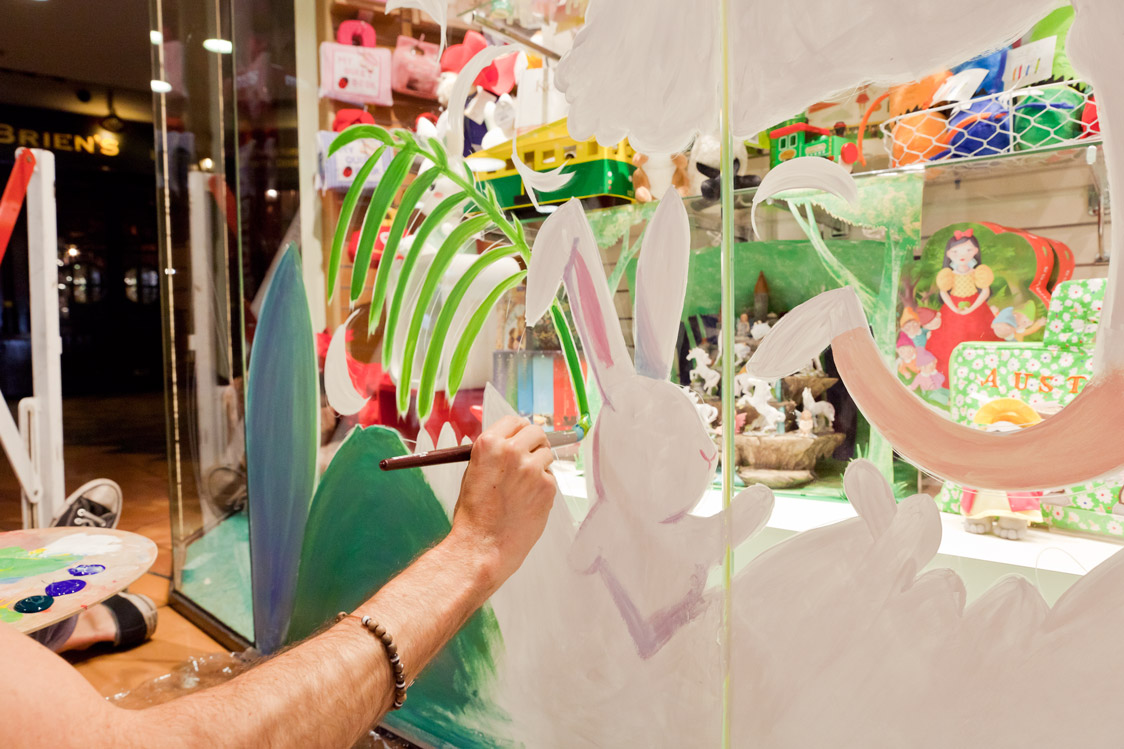
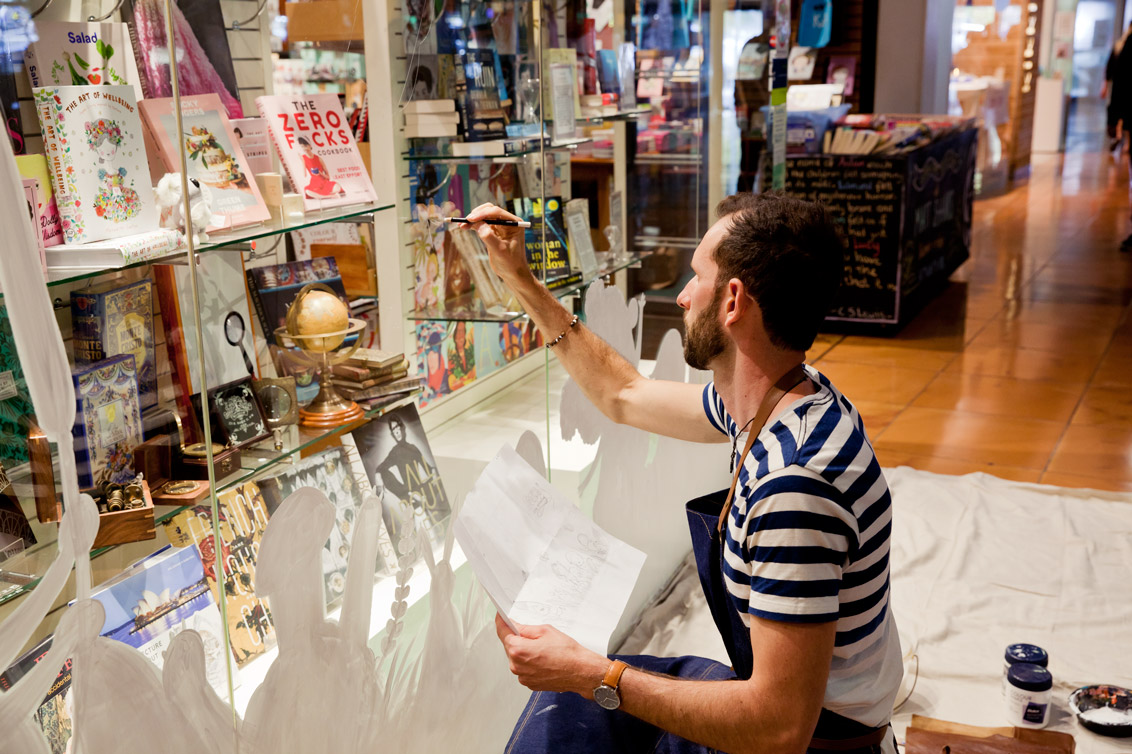
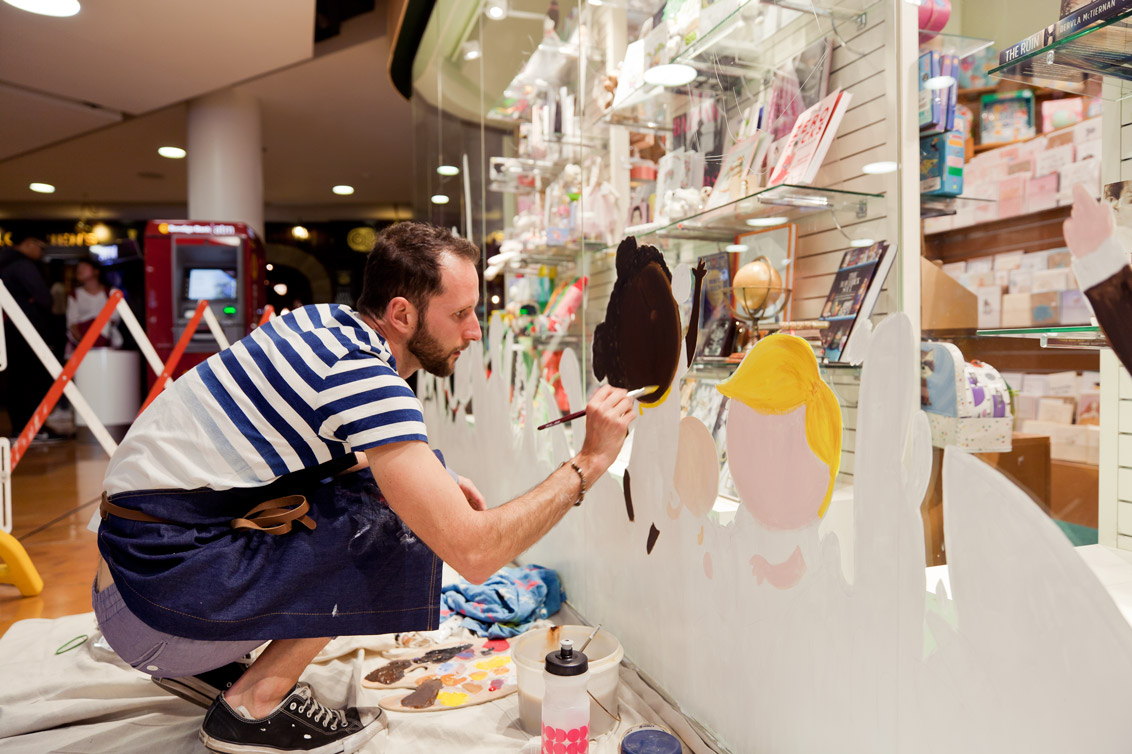
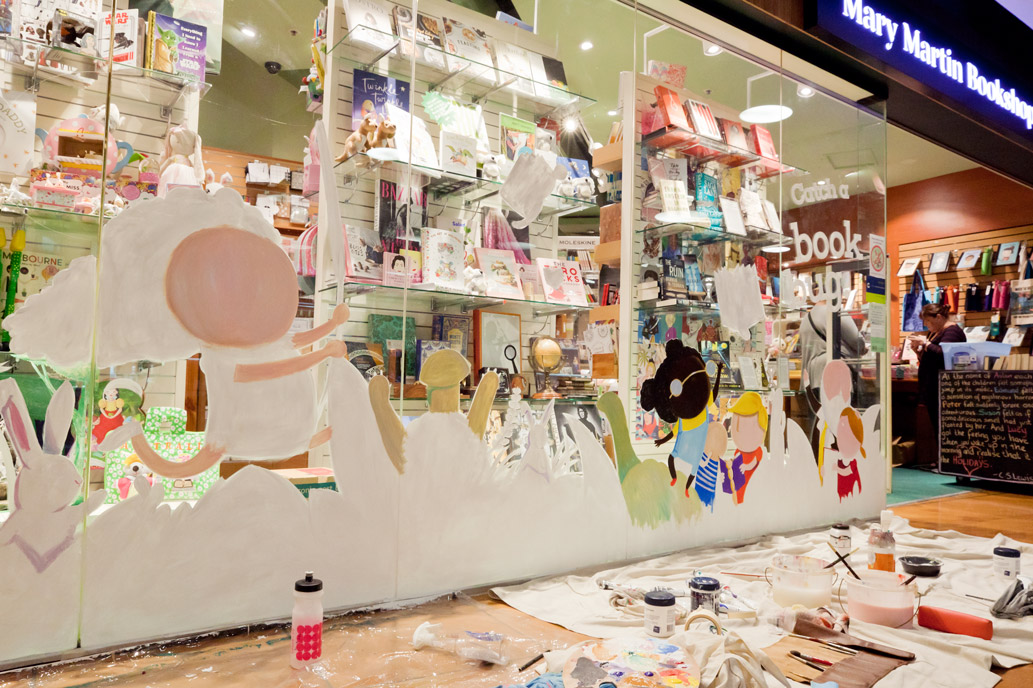
Matt starts to apply colour to a white undercoating
For the Mary Martin mural, I had a hard time limit. Two days. 10am – 6pm. And, having never done this before, I had no idea whether it was too much time or too little time. So, I made sure the final concept was adaptable. This is where painting like an oil painter helps.
I’ve heard this best described as painting like a camera lens sees the world. The idea is to avoid focussing on one character or part of the drawing and getting it to completion but rather work across the whole drawing early. Block in big shapes and then, as you go, you spend more and more time adding levels of detail across the entire painting. The camera lens analogy is a good one. It’s like starting off with an unfocused image. You can see large blurry shapes and colours and values. Then, as you tweak the lens, you slowly bring the image in to focus.
Don’t focus on detail too early. Block in big shapes to make sure that if you run out time, you don’t have a half-finished mural
Painting in this way means that if you run short on time, you’re not left with one or two characters finished and the rest of the canvas untouched. It means that everything is somewhat coloured in and what’s probably missing if you run out time are particular details around clothing or hair, but you can get away with not having these if time is an issue.
Typography
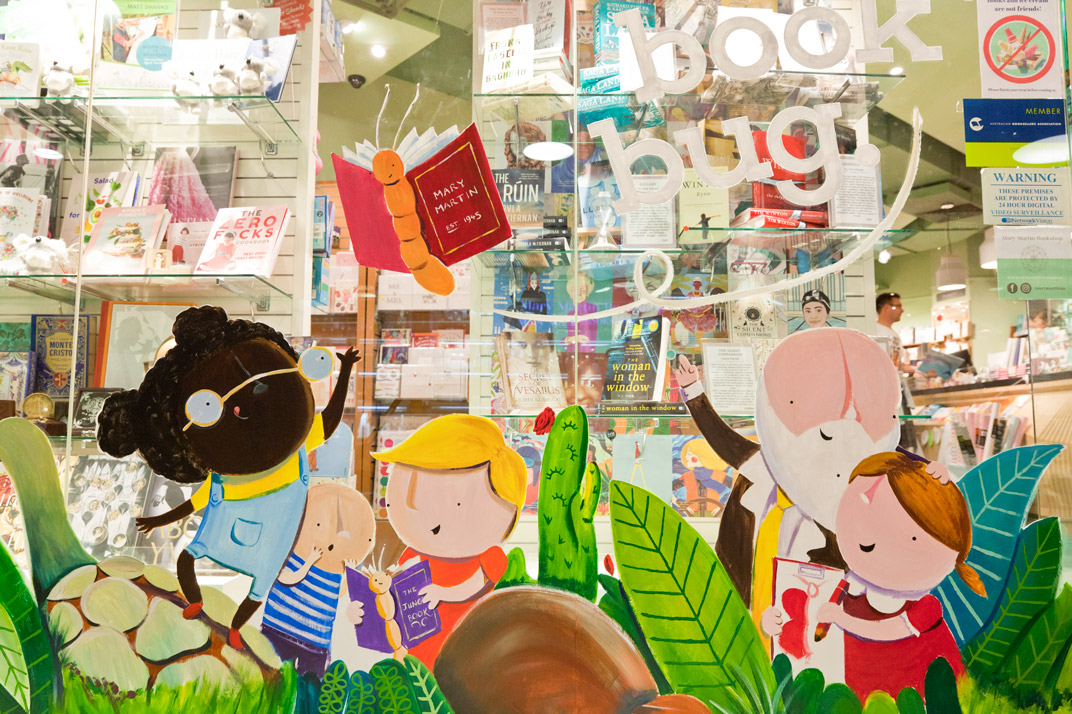
The “Catch a Book Bug” words were expertly painted by Melissa Hill
I have to admit that my partner came to the rescue. While I was busy painting our home windows, Mel’s graphic design skills came to the fore. We designed the typography layout together on the computer, then printed it out, tiled, across 6 or so pages. This gave us something to trace directly on to glass.
By this time I had cracked the ‘how to paint on glass’ mystery, so I was able to guide her with my ‘expert’ eye for how to use white house paint on glass. This touch of beautiful typography really lifted the whole design.
Logistics
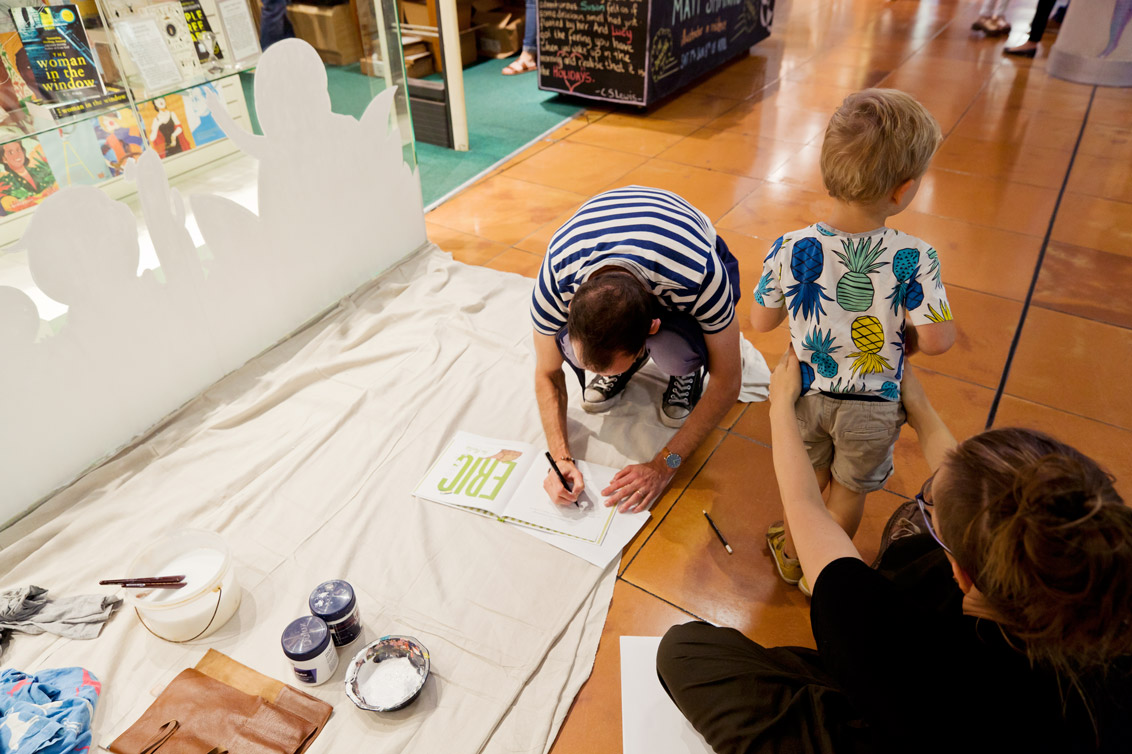
It’s important to budget time for curiosity and interactions with the public (yes, book signings)
Painting on location is always fraught with uncertainty. I’ve done enough sketching on location to be aware of things like water sources, clean up facilities and so on. Here’s a list of the things we had to consider for the Mary Martin mural.
Wash up spaces: With five metres of painting, there would need to be a lot of wash up. I needed, at minimum, a sink with running water.
Exact sizes: Doing all of this prep work at 1:25 scale is not particularly useful. Given that the window is the bookshop’s primary chance to lure people into the store with their beautiful displays of exciting books, I needed to go in a number of times to get exact measurements of how high the mural good be without getting in the way of the book displays.
Parking/Cost of parking: Getting to and from the venue is always something to consider. With a lot of painting supplies, we needed easy access to the car at all times during the day. Fortunately for us, the car park at Southgate was excellent both in cost and location.
Lunch breaks: When I paint, I lose myself. I get in a flow state, and I can go for 12 hours without remembering to eat; that’s only when I’m at home alone. Painting in public is even more exciting because you’re having conversations with people, inspiring little kids to paint and draw themselves, and signing books. Taking lunch seems like an inconvenience, but it’s SO important to be able to sustain your energy. If there aren’t any cafes or shops near to the site, don’t forget to pack lunch and a thermos of tea.
Safety barriers: We were painting in a mall, so barriers were provided for us, but it’s important to have something to demarcate your space. Not only do you need it for public safety, but it’s just WAY more comfortable to paint when you’ve got some space that you know people won’t invade. If they had their choice, people would come right up to the glass to have a chat. Can you imagine just finishing a piece only to have a member of the public accidentally lean on it or smudge it!
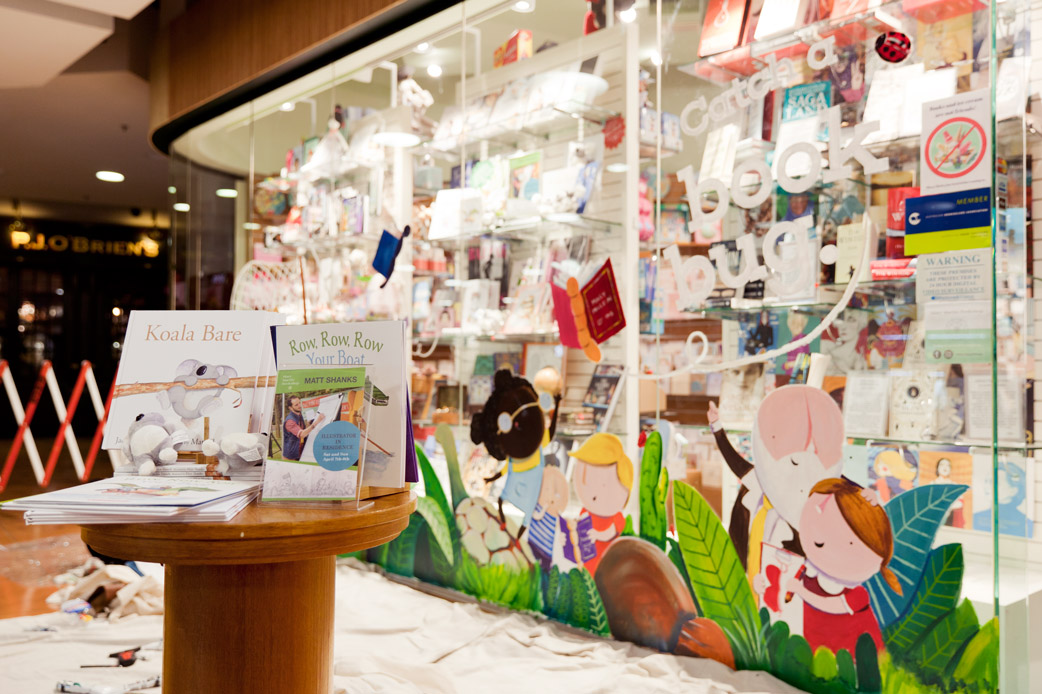
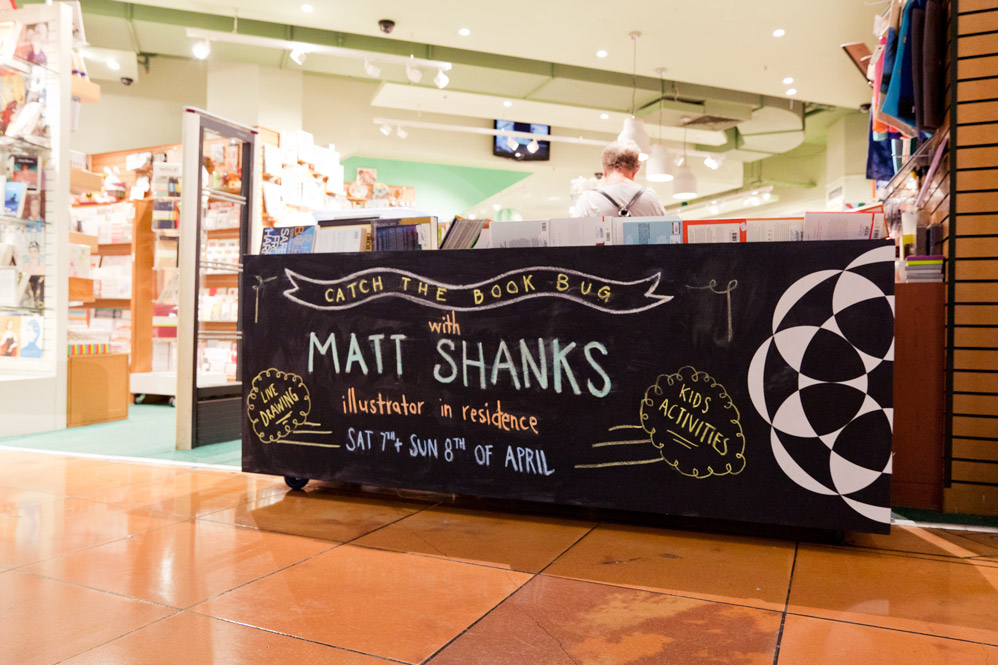
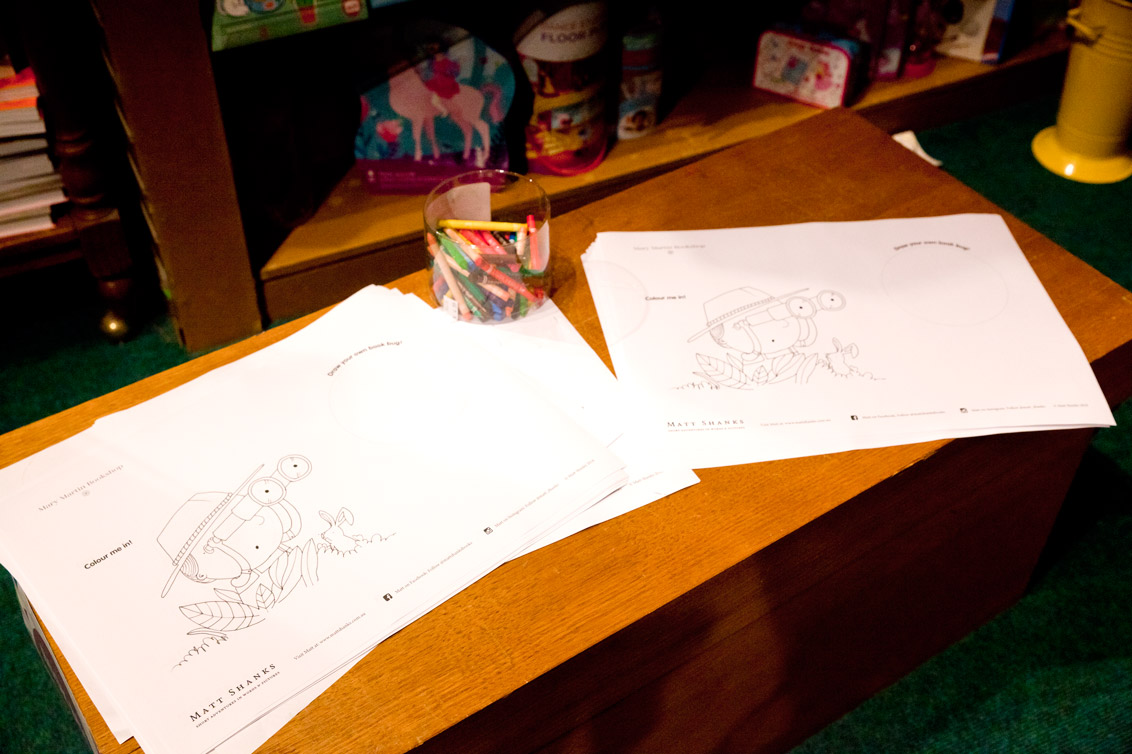
Marketing/Colouring in activities: Painting a mural for a bookshop is more than about ‘just painting a mural’. Bookshops are a kind of heartbeat in our community. They bring people of all ages together – hunters looking for their next literary adventure. Having an artist-in-residence is a special thing for a lot of people, and so if there’s anything you can do to make that experience more special, I believe it’s your responsibility as an artist to do that. For Mary Martin, I made some bespoke colouring sheets and bought a pile of crayons for the kids to use. I wanted them to make their own art as so many often want to do when they see an adult painting. It’s such a natural experience for humans to do this and I figure if I’m lucky enough to have found the confidence to share it, then it should benefit as many people as possible, not just ‘the client.’
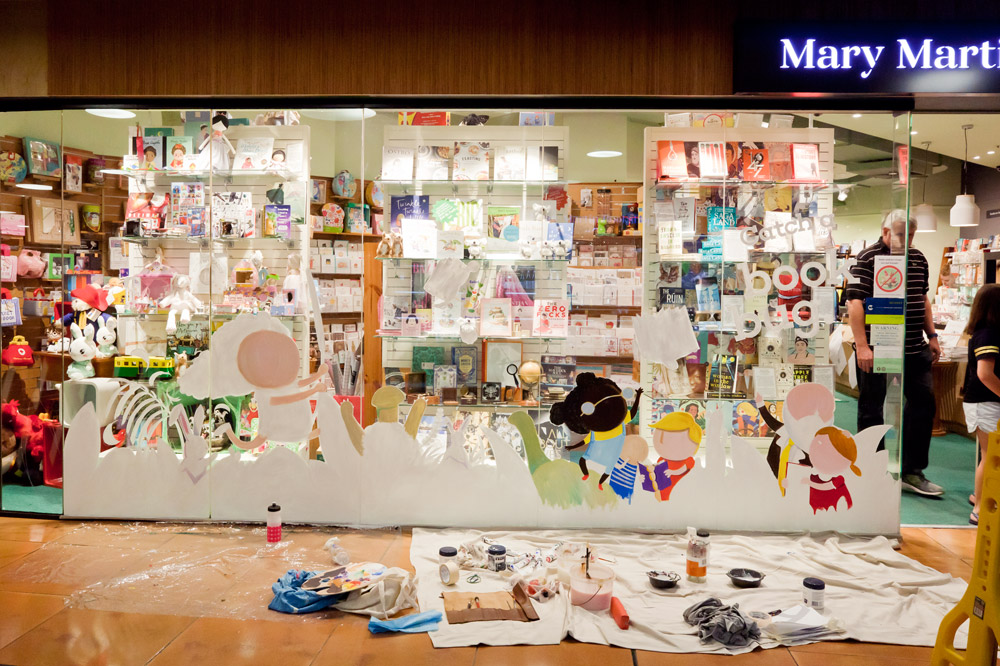
The final result
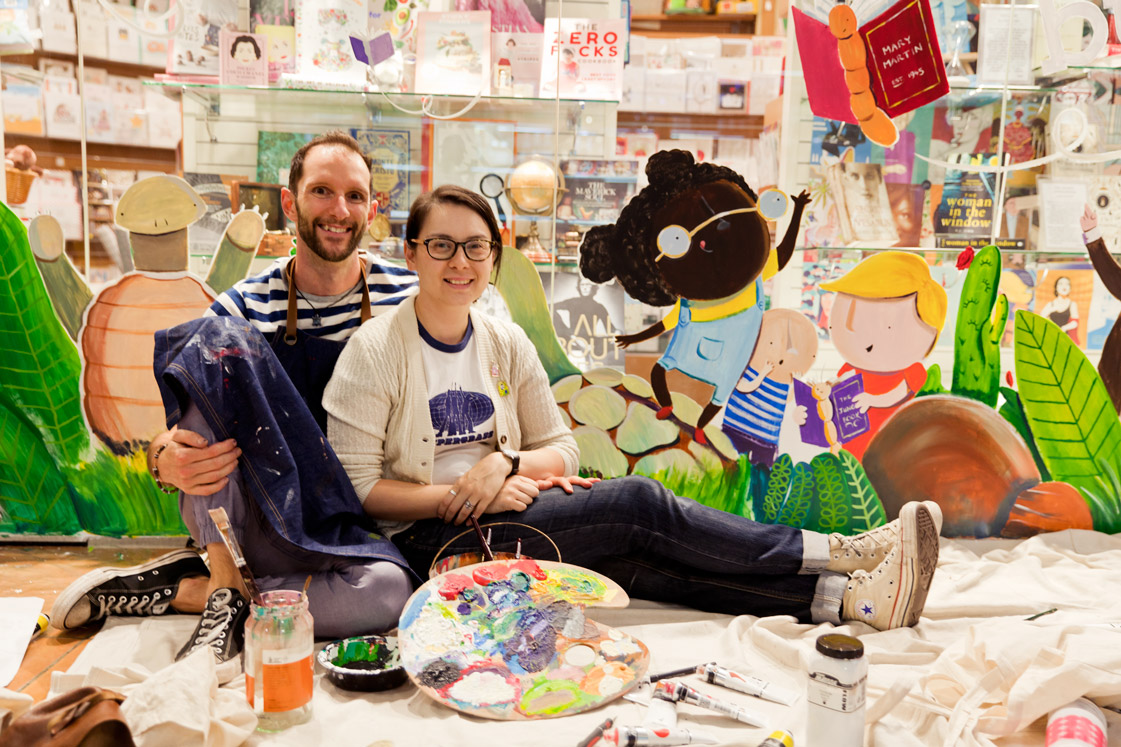
It was such a success! The bookshop loved it, the public loved it and, well, I was a little bit proud of it myself. I am also HUGELY thankful to my ever-supporting wife Melissa who not only helped with the painting but also documented the 2 days so beautifully with this lovely collection of photos.
As an artist, it’s easy to think you’re selling art, right? That thing you spent hours or months slaving away at. That final piece that someone will hang on their wall in their home and call their own? The layers of paint, expertly placed just so. It’s taken years of experience to get to this point. The point when you can call yourself an artist?
But I’m not sure that artists are selling only the final piece. See, I’m starting to think that there are two types of buyers. I don’t know what to call them but here’s what characterises the difference.
Two types of buyers
The first buyer is the one who’s buying the commodity. The thing that looks nice. The thing that matches their rug, or their couch, or their child’s space-themed nursery. They’re the sort of buyer who is happy to pay you for it, but, if they can get it cheaper elsewhere, they will. They’re the type of buyer who feels that, should Target or K-Mart steal your work from Instagram and mass-produce it, there’s no difference. It still matches their rug.
The second type of buyer is the one who purchases the story. Sure, they like the final piece. It probably still matches their rug, or couch, or their child’s space-themed nursery. But, they’re the sort of buyer for whom originality matters. Where mass-production somehow devalues the piece. These buyers are willing to pay more (although every buyer is still price-sensitive). And while it may seem that, even to the buyer themselves, they are buying the art, what they’re actually buying is more than that. They’re purchasing a license to tell your story.
Buying stories
When both buyers hang your art above their couch, the surface-level experience is mostly the same. Friends come over for a dinner party and applaud both buyers on their stylish curation and expert taste in interior design, “Wow, you’ve got such great taste,” they say. But it’s at this point where the similarities stop; the buyer must now respond to their friends’ gushing kindness.
The first buyer responds with gratitude and then overwhelming excitement for the deal they got. “Can you believe I got this from K-Mart for just $15?” They say. “Some artist is trying to sell these on Instagram for like $300!” And, it follows that their friends are stunned by the bargain and heap congratulations on this buyer for their bargain-hunting prowess.
The second buyer, however, responds quite differently. They paid the $300 price tag, direct from the artist, and they still feel as though they have a deal. That’s because they’ve bought something quite different. Yes, they’ve still got the final piece. But, instead of focussing on the cost, they spend 15 minutes sharing a story of making a connection. They purchased an original directly from the artist, they say. They browsed the artist’s site for months as they saved to buy this specific piece. They emailed the artist back and forth and built a personal relationship with them. They might even call them ‘an artist friend they know’ now. They talk about how this piece was created en-plein air on the artist’s recent travels to Croatia. They followed the progress of the painting on Instagram. They know that it, in fact, took over 300 hours of work, 3 months to complete, and while the artist was doing so, they were incredibly nervous about how it was progressing. There’s online evidence to share with their friends.
The story of the second buyer is rich. It’s full of emotion, human connection, struggle and achievement. It’s as unique as the painting itself. Their friends are on tenterhooks; they pick up their phones and follow the artist on their social media channel of choice. Through association, they feel they know you already. Because of the story that the second buyer has purchased, the piece maintains an exquisite central presence in their home for many years. When the couch is no longer in fashion, it’s not the painting that goes, but the new couch is selected to match the painting. The story gets told and re-told. Again and again, as new friends and connections are made. The artist gains more attention and admiration. One friend contacts the artist directly, “You did this for my friend, I’d like something similar too.” Which is code for, “Can I have a story like that?”
Meanwhile, as time passes, the first buyer tires of the painted reproduction they bought from K-Mart. Once out of fashion, it loses its value. The story of the ‘bargain buy’ is one that everyone has experienced, and since the reproduction was reduced not long after it was purchased (because technology continues to make it possible to make more of them for less), now $15 seems expensive. When the first buyer looks upon their piece, they don’t feel elation or deep emotional connection. The feeling changes to one of negativity and ‘being screwed over yet again’. Art is fickle, the first buyer thinks. The mass-produced reproduction is left out for hard-rubbish, bitterly disposed of. It’s replaced with something else of equal or lesser value but at least it’s on trend, and still probably a bargain.
David and Goliath
As an artist, you can feel powerless when you’re facing the beasts of scale and mass-production of chain stores who can produce or reproduce popular art at a cost at which you cannot compete. But that’s only if you’re viewing your own art through the same lens as buyer one, just a painting. You’re comparing apples with apples.
But see, when you make your art, it’s not about apples vs apples. You’ve got something incomparable – the story behind your art. The process, the pain, the hardship, the excitement. There are buyers out there who value these things. Yes, they’re buying your final piece, but they’re also purchasing your story. They’re purchasing connection. And, in a world where we’re all starting to feel increasingly disconnected, the value of this connection that we make through art is becoming increasingly sought after. People are buying followers, why wouldn’t they also be buying relationships with artists?
Are you selling art or stories?
In the end, this comes down to how you’re selling your art. And how you’re selling your art comes down to what you think you’re selling. Are you selling your story? The story of how the work came to be? Are you putting in the work to show people your process? Are you giving them an inside look into a world that feels so unattainable for so many; people who feel they can’t produce what you can?
If not, are you surprised to learn that buyers will choose the cheap K-Mart reproduction over the single image you upload? If you’re not sharing the story, all you’ve got is an image that has no context or background. No story. If the image is everything, K-Mart will do.
So, which buyer do you want and what are you doing about it?
I have a confession to make – I’ve never suffered from creative block. What’s my secret? I think it’s acknowledging that creative block doesn’t exist. “What?!” I hear you say. Please, bear with me.
One of my favourite thinkers is Seth Godin. He’s been running a blog for years and posts Every. Single. Day. They aren’t long posts, in fact, they’re super short and snappy, but the ideas within them are deeply profound. Well, at least to me. It’s fair to say he’s been a significant influence on the way I approach my artistic work. To say he’s ‘changed my life’ is probably not overstating it.
In 2011, he posted an article called, “Talkers’ Block.” It’s a humorous look at why people seem to accept the notion of Writer’s Block with ease, but no one ever seems to be lost for words when they’re speaking.
He writes:
The reason we don’t get talker’s block is that we’re in the habit of talking without a lot of concern for whether or not our inane blather will come back to haunt us. Talk is cheap. Talk is ephemeral. Talk can be easily denied. […] Writer’s block isn’t hard to cure. Just write poorly. Continue to write poorly, in public, until you can write better.
Whether it’s fate or just my habit of reading widely, the ideas from a marketer and two artists came together, and 2014 became a formative year for me. I wasn’t blocked from making art at all; it was just two stupid things: I de-prioritised art over other things, and I was full of fear of making work I was embarrassed by.
Art won’t make itself. You have to take the leap and make it real. You need to put actual strokes to actual canvas or real pencils on real paper. And yes, it’s scary. And it’s hard because our brains are wired for laziness. At the basic level of survival, if we’re safe from sabre-tooth tigers, we can rest easy. It’s much easier to sit in front of Netflix and just think about how you know you could easily make that great painting or drawing at any time. It’ll happen one day.
Fear makes its own distracting habitat
A few years ago, my evenings looked a little like this. I used to sit on the couch and watch some TV series that I was thoroughly enjoying at the time. This activity, whilst mind-numbing, wouldn’t occupy all my brain space. While I was watching, my attention would drift, and I was able to dream up an image, or a character, or a landscape that I could be painting instead. At that time, thinking about it was enough. It satisfied me. I knew I could actually DO it if I really wanted to. But there’s only an hour or so at night after work and dinner and then it’s bed-time. The last thing I wanted to do was get all my art supplies out. By the time I did that, then there’d only be 30 mins left before bed and that wasn’t nearly enough time to make art.
There’s no creative block hiding in the cupboard
Then, one day, by reading Art and Fear and Seth Godin’s blog in close succession, I was inspired to act. I actively decided to change a habit.
On Sunday night, I got my art supplies out. Just a notebook and a pencil and eraser. It took all of 5 minutes (not the 30 minutes I imagined it would). I put these art supplies right by the couch where I knew I sat each night after dinner. On Monday, I used them while having the TV on in the background. I drew horrible, terrible things. Things I will never show anyone. After half an hour, I looked at the page and it was a mess. I wanted to erase the whole damn thing. Instead, I flipped the page and started again. The second page was better. Things began to resemble a little of what I could see in my head. It was still terrible, but less terrible.
Then it was bedtime.
The next night, after dinner, I casually flicked through the notebook again. I looked over my previous work. Most of it was still rubbish, but there was something in a particular drawing I did that gave me the motivation to refine it a bit. So, I started drawing a better version of it. In fact, I drew three better versions of it. Each one better than the previous. By the end of that one hour, I had something compelling enough to want to colour it in. But, it was bedtime again.
On night number three, I dug out my watercolour set. I was given it for a Christmas present two years earlier. I was so ‘fearful’ of producing bad work it sat idle in a draw for all that time. But not this night. I had a drawing I was happy with, so I started to colour it in. The result? I completely stuffed up the whole thing. I mean, a complete disaster. I wanted to throw the entire thing out, along with all my art supplies. In the bin, forever. Anyway, by that time it was time to go to bed again.
Wearing armour for overcoming fear
This went on for weeks. I did a little bit, hated most of it, but found something small in everything I did each time. Whether that was a particular gesture, body position, colour choice. There was always something that made it motivating to continue.
See, what no one tells you is that an art practice is generative. The more you do it, the more you begin to learn to see things to improve. That gives you more motivation to improve those things and the snowball gets larger and larger until, well, you begin to identify as an artist. It took me three years of this practice, a 3-book deal with a publisher, and some industry recognition before I started to think, “Hmm, maybe I am an artist?” Only now am I starting to truly feel comfortable and value my own work in this way. And, it’s still not good enough. I’ve still got a long way to go.
Creative block is a mythical beast
There’s no mystical ‘blocking’ force out there. The universe isn’t out to stop you making stuff. It turns out that Seth is dead right – It’s quite simply fear. Fear to be found out for the imposter that you believe to be but that no one else recognises.
In the end, the only difference between an artist and someone who isn’t an artist is that the artist does the work, even when that work is terrible and it feels as though there’s no light at the end of the tunnel. Note to self: there’s always light, just show up every day and do the work to find it.