
I thought my critical-thinking abilities were an asset to my illustration career. For every book I’ve worked in the questions often begin the same way – “who is it for and how, what are we trying to achieve?” It’s become my core approach to everything I do professionally and the decisions I make in life.
And then I watched 10 Years with Hayao Miyazaki and he said a few simple words that have stuck with me over the last few weeks – kids are illogical. And he’s right. They are. And so what might happen if I turned off my critical-thinking abilities and did something even more difficult than logic – what if I worked to get my imagination back?
What if things didn’t make sense, sometimes?
What would the world be like if fish were feathered? If cows could fight back? If the sky was blue not because of the way light refracted through the atmosphere from the sun but because of a faded stain left behind by a celestial squid. What if, for a moment, the world didn’t make sense. What if anything went?
The thing is, as an adult, I don’t really know how to develop more imagination. No one, it seems, teaches that. When I search online I get suggestions for improving memory – but that’s not imagination.
At the risk of using logic to solve this problem, if kids are illogical, maybe I need to do what kids do?
I know that drawing helps me, but not the sort of drawing where I set out to produce an image I can already see in my head. No, it’s the process of seeing abstract marks made on paper then making something of them *afterwards* has always been good for unlocking unusual ideas.
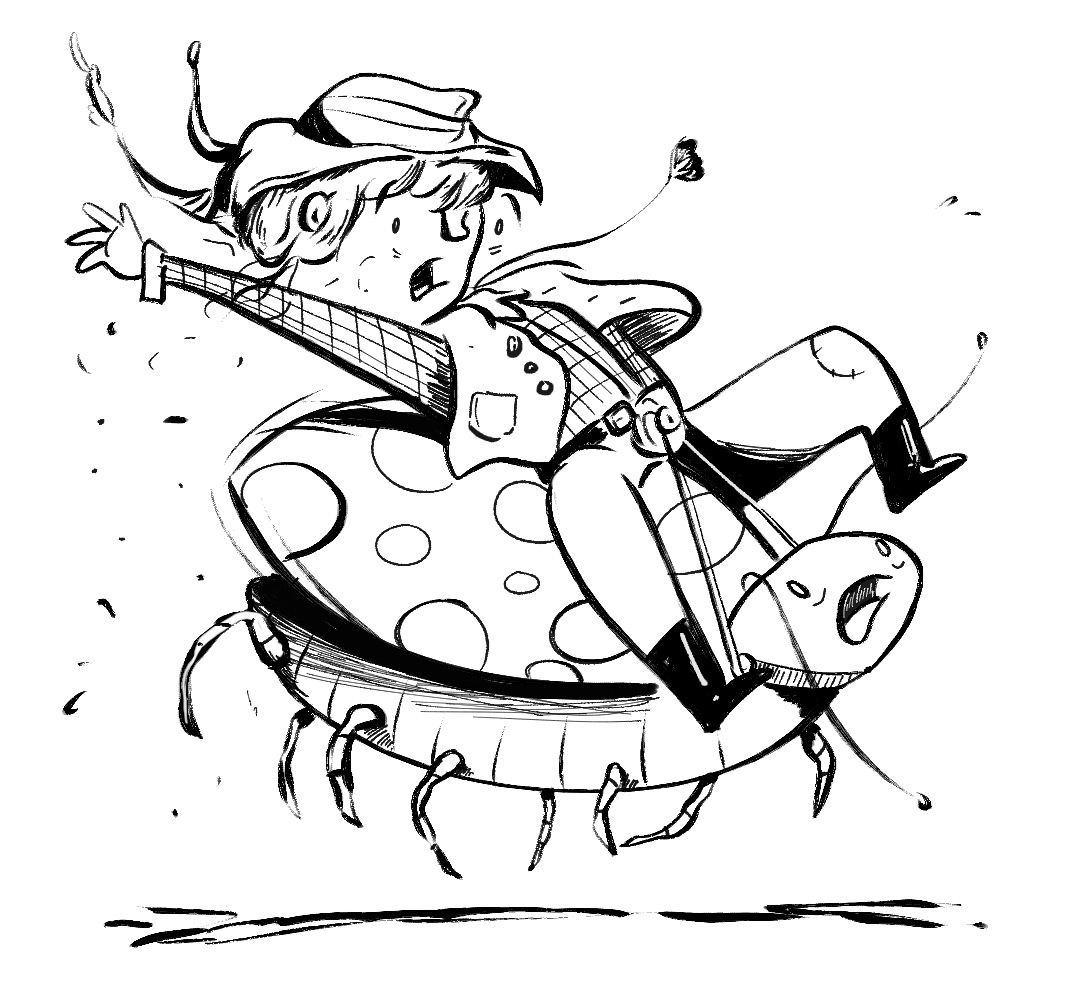
Thinking in ‘opposites’ may help, too – feathers and fish don’t typically go together. Neither do cows and combat. Perhaps a turtle can be as fast as a cheetah? Perhaps ladybirds are a mode of transport. Perhaps a spider’s venom is healthy not deadly. As I write those sentences, I find they are leading to more sentences. Intentionally breaking the rules that have formed the boundaries of our world seems useful.
And finally, there is, of course, telling fibs. Or, in other words, making up my own reasons for things, as kids often do. Instead of asking “why the sky is blue?” perhaps it’s more about asking, “why do I think the sky is blue?” and then just making things up, like I used to when I was a kid.
Of course, all these strategies seem so logical – a way for my adult self to unpack a problem and use reason to generate ‘solutions’ – but maybe imagination begets imagination? Maybe it’s not about throwing logic away completely, but building the imagination muscle so they can work together to produce something unreal that feels real, all the same, just as Miyazaki does.